Thursday, January 10, 2008

Richard Aoki , Berkeley Barb Feb. 14, 1969 pg.4


Berkeley Barb Feb.14-21 1969 pg. 4 article reprint

TWLF LEADER TELLS WHY HE’S WHERE IT’S AT

By Phineas Israeli

“ ‘As a child I was interned for four years in concentration camps in San Mateo and Utah.’

Richard Aoki takes another drag on his cigarette and continues to carefully and unemotionally describe his life under the gun of American racism.

Richard Aoki is a spokesman for the Third World Liberation Front at U.C.Berkeley.

After WW II, the Japanese-Americans were liberated from the ‘relocation centers’ and Richard began his education in black ghetto schools in the Bay Area.

‘Of my junior high graduating class, more than 5O% have been in jail or are in jail now. I see this as a reflection of their being unable to achieve a standard of living through traditional means.’

Richard attributes his schoolmates’ alienation from traditional means to the West Oakland ghetto’s ‘high rate of unemployment, sub­standard housing, inadequate educational institutions, inferior medical services, and constant police harassment.’

One high school teacher advised Richard that ‘I’d end up in San Quentin five years after I got out of school.’

‘I took it on a very personal level when they vamped on me, but in retrospect,’ he says now, ‘I see they couldn’t have acted in any other way because of the racist nature of the institution.’

When he was 17 Richard signed up for the Army hoping to attain a measure of ‘vertical mobility.’ He was offered a commission ‘but I told them I wanted to do some other things.’

After the Army Richard spent two years at a junior college in a pre-med program. But, ‘I gave that up upon being convinced of the racist nature of the medical profession. There is no institution in this country that doesn’t have it.

‘I started asking around about medical schools and found that there was quota system for Asian-American.’

Having failed to Find a racism-free :one in either the service or school Richard went on the road. He spent six years ‘wandering about the country, just seeing what it’s all about.’

Along the way he worked as a truck driver, hospital orderly, clerk and factory hand. He learned two things: that there aren’t any areas in this country really free of racism, and that his thing was to work for the Asian-American community.

‘I became convinced that this is my country, and if it’s going to become a more positive society then I have to stay here and help.’

Leaving the road, he returned to school, graduated with honors in sociology, and is now a grad student at UC. The Third World Strike is his way of creating a racism-free zone for this country’s Third Worlders.

‘I think the strike’s going on quiet well. Morale’s quite high, we still think we’re going to win.”

Richard believes the Third World College will help the minority communities by creating ‘a circular thing where the youth leaves the community, comes on campus and then goes back to the community.’

The TWLF has put a great deal of energy into building strike support in the Third World community. ‘If we convince them that we’re fighting in their best interests, then there will be another dimension to the struggle.’

The Front expects this support to materialize Thursday (BARB press time) on campus, and the future direction of their strike depends on Thursday’s turn-out.

‘The Third World College will be instituted at U.C.’ Richard says flatly, ‘it’s just a matter of time. The strike is a manifestation of the question of who’s going to control it.’

Though the TWLF has received a favorable response from some faculty and administrators, ‘the main sources of power at the university have indicated an intransigent attitude of non-cooperation with the Third World Liberation Front.’

The Front is aware that many white strikers are dissatisfied with the strike’s tactical pace, but ‘they haven’t seen anything yet, we’ve just started.’

‘Multi-faceted systems of pressure will be exerted on the University.’

‘Nothing much has really happened here -- a few beatings, a few fights on the line, petty acts of vandalism which we disavow, I personally disavow petty acts of vandalism because they’re petty.’

Richard allows that the TWLF at Cal is not in the same place as the Front at State. He says that the Cal branch of TWLF still considers itself to be ‘responsible’, and has been trying ‘to keep a lid on things.’

But he warns that the powers in the University had better move quickly to meet the demands before the lid flies off and ‘everyone does his own thing.’ “


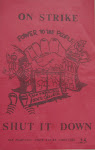
Photos from UC Berkeley TWLF Strike 1969


UC Berkeley TWLF Solidarity Newsprint 03/1969

Solidarity TWLF Demands UC Berkeley 1969

Solidarity!

"The Third World Liberation Front demands the following:

1. That funds be allocated for the implementations of the Third World College

a. Department of Asian Studies—that positions and staff be set up to develop the Asian Studies Department controlled by Asian people.

b. Department of Black Studies as proposed by the AASU.

c. Department of Chicano Studies

d. Any other ethnic studies programs as they are developed and presented.

2. Third World People in Positions and Power

Recruitment of more Third World faculty in every department and discipline and proportionate employment of Third World people at all levels from Regents,

Chancellors, Vice-Chancellors, faculty, administrative personnel, clerical, custodial,

Security, service personnel, and all other auxiliary positions and contractual vending services throughout the University system.

Specific demands for immediate implementation;

a. hiring of Third World Financial Counselors (Special Service

b. Third World Chancellors in the University System

c. Third World people put in the Placement Career as Counselors

d. Third World Deans in the L and S Department

e. Third World people in the Admissions Office

3. Specific demands for immediate implementation:

a. Admission, financial aid, and academic assistance to any Third World student

with potential to learn and contribute as assessed by Third World people.

b. 30 Work study positions for the Chinatown and Manilatown projects, and 10

EOP counselors, including full-time Asian Coordinator.

c. Expansion of Work study program Jobs to the AASU East campus

High School Project, to include at least 30 positions.

d. That the Center for Chicano Studies be given permanent status with funds to

implement its programs.

4. Third World Control over Third World Programs

That every University program financed federally or otherwise that involves the Third World communities(Chicano, Black, Asian) must have Third World people in control at the decision making level from funding to program implementation.

5. That no disciplinary action will be administered in any way to any student, workers, teachers, or administrators during and after the strike as a consequence of their participation in the strike.

6. These demands supercede any previous demands heretofore put forth by members of the Third World Liberation Front."

Third World Liberation Front

Solidarity AAPA Demands UC Berkeley 1969

photo: UCB TWLF Strike picketline (AAPA Newspaper 1969)

Solidarity Newsprint

Asian Studies Proposal

(Submitted by the Asian American Political Alliance)

GENERAL PURPOSE AND PRINCIPLES

The Asian experience in America is unique. The lives of the Japanese, Chinese, Filipino, Korean, and other Asian people have similarities and differences, but generally fall under the category of the Yellow Experience. The phenomena of a colorful people living in a white society deserves study, understanding, and sensitive analysis. It deserves this study because these colorful people need it, in order to understand themselves and the society in which they live.

The effects of American and Western civilization on the non-Western world have been profound. From the earliest contacts of European explorers with the Chinese and

Southeast Asians to the present-day Western military, economic, and political activities and spheres in Asia, the 'white' man has been involved with the ‘yellow’ man.

From the study of these two related experiences- Asians in America and Westerners in Asia—we can perhaps arrive at some understanding about the ‘yellow-white' relationship at its social and psychological roots and manifestations:

Specific Course Proposals

the Asian in America

A) Social Psychology: Dynamics of Racism

The natural alliance of peoples of color results from the exploitation according to and exclusively because of sheer visibility. In this sense, it is simplest put that we know when we are being lied to. Such a perspective as we are attempting to develop could not necessarily emerge from a view of American culture only. We take heart and example from the continued existence of our culture abroad, which proves to us the viability of our heritages the world over.

To explore the social psychological dynamics of being yellow in a white society.

Method: experiential, accounts, testing, group discussions, reference groups, interpersonal relations. Specifics for Chinese, Japanese, Filipinos, ghetto, middle class, wealthy.

B) The Asian and His Community

Chinatowns: Development, problems, characteristics

Filipinos: Uniqueness, characteristics, etc.

Identification with community; alienation from the same.

Living in White society: Implications on community identity

Japanese Community: Where? Characteristics, etc.

C) Relationships Among Asian Communities

A study of the inter-community tensions and harmony: distances, effects of national origins, the rural-urban and middle class ghetto relations, and the historical effects

American society . . . - e . g . relocations, politics, economics.

D) America, An Asian Perspective

Political Economy of America

Anti-Asian laws: History and Meaning

The ‘White Man’: What it means????

Our Piece of the Pie: Its value… acculturation, accommodation, and affluence.

E) Community Workshop: Relevant Education

A major problem of the ghetto is the failure of its youth who are fortunate enough to learn a skill, to return the benefits of that skill to the community. This problem is neglected by the existing educational system, which prepares the individual for the assumption of an economically productive position within society. The skilled individual who can and does return to aid the community is the exception, not the rule. The Third World individual who does return is an even greater rarity because the University which already produces too few of these individuals has few Third World people initially and lacks the relevant courses catering to the specific needs of the community.

F) Language: Contemporary Linguistic Skills

The problem of language: dual life and language as presented by immigrant life and handicaps presents the need for Cantonese as well as the desirability of other Asian languages as spoken in the United States.

G) Creative Workshops -

Using traditional and non-traditional media, drama, literature, mass communications, art, music, photography, etc.; in workshops that would develop an Asian American perspective through unique and various art-forms.

The Asian Experience:

The roots of the Asian-American lies in Asia. A knowledge of history is essential;
most pertinent is history involving Western man. Our course offerings in this part of the department would thus center around the nature of the Asian person, and his relationship with Western man. We include the study of ‘Overseas Asians' in this focus, because most Overseas Asians remain in Asia outside of their national origins. Also, Overseas Asian (except Asian-Americans) are distant from America. Community work there is difficult: histoty and current literature are the best we can do.

A) The Roots of Asian Man: Social Conditions for Emigration

Social Structure--Family, Occupations, Politics, and Religion

Economic Condition-labor opportunities, poverty, mobility, class conflict

Western Effects--War, trade, etc.

B. Westernization of Asia: Imperialism, Colonization, Modernization and Effects

Europe: 15th thru 20th Century

America: 19th thru 20th Century

The study of cities—Hong Kong, Shanghai, Tokyo, and Singapore—as case studies in westernization . . . a study of customs, values and social perceptions.

C. Overseas Asian Communities

Asians in various contexts: Europe, Africa, Middle East, and Asia in comparison
with Asians in America.

D. Asian Revolutionary Ideology: Communism

A core course on ideology, organization of communism in the Asian countries

Eg: China and the thought of Mao.

E. Revolutions and Social Movements

Student Movements in Asia

Conditions for Revolution in Asia

Effects of the West in Revolution and Unrest in Asia.

Solidarity TWLF UC Berkeley 1969 Sather Gate Rallies


Photos from Solidarity Newsprint 1969