
AAPA at 1968 Greek Theater UCB Anti-War Rally
Welcome to the Asian American Movement 40th Anniversary collection from the archives of the Asian Community Center (once located on Kearny St. in San Francisco). We focus on 1968 because that year was the beginning point for the Asian American movement. 1968 witnessed world changing events and many Asian Americans responded to make the world a better place for humanity. This project is sponsored by the Asian Community Center History Group. Email project at ewbbinfo@yahoo.com
January 1968
Tet Offensive in Vietnam, Viet Cong temporarily seized the
Mar. 3, 1968
More than 1000 Chicano students walk out of
March 1968
My Lai Massacre was the mass murder of 347 to 504 unarmed citizens of Vietnam, mostly women and children, by
March 1968
SFSU Third World Liberation Front was formed with the Black Students Union, the Mexican American Student Confederation, the Philippine American Collegiate Endeavor (PACE), the Intercollegiate Chinese for Social Action (ICSA), the Latin American Students Organization, and an American Indian student organization. The Asian American Political
April 4,1968
Assassination of Martin Luther King Jr. His murder was followed by urban riots nationwide in up to 76 cities
April 6, 1968
Bobby Hutton, 16 years old and the first Black Panther Party recruit, was killed in
May 1968
Asian American Political
SFSU TWLF staged a sit-in at President Summerskill's office. Resulted in opening of 412 admission slots for TW applicants over the next two semesters, and the creation of at least 10 faculty positions for TW professors. Sit-in also involved first major act of police violence against student demonstrators with clubbings, ten injuries requiring hospitalization, and twenty-six arrests. Summerskill resigned a few months later and there was no fulfillment of earlier agreements. Student frustration leads to divergence from traditional protest channels.
June 30, 1968
Berkeley mayor Wallace Johnson declares a state of emergency and a three day curfew in the city in response to violence in the wake of student demonstrations in support of Paris, France May Uprising of students and workers the previous month.
October 28, 1968
First eviction notice was served on 196 International Hotel tenants, mostly elderly Filipino and Chinese men. The tenants were given until the first of January 1969 to leave. Milton Meyers Co. owned by Walter Shorenstein planned to demolish the building to build a parking lot..
November 1968
November 28-31, 1968
AAPA was part of a S.F. Bay Area delegation to the Montreal Hemispheric Conference to end the Vietnam War.
November 28, 1968
Free
January 10,1969
UCB African American Students Union began to discuss publicly the need for action, including a possible strike. The AASU, Mexican-American Student Confederation (MASC), and the Asian American Political
January 11, 1969
Asian American Experience/Yellow Identity Conference held at U.C. Berkeley. Sponsored by Chinese Students’ Club, Nisei Student’s Club and Asian American Political
Next day Statewide AAPA meeting held at U.C. Berkeley after the Yellow Identity Conference.
January 21, 1969
UC Berkeley Third World Strike begins.
March 16, 1969
Community and tenants protests forced a new International Hotel lease agreement to be signed on this day. But instead an early morning arson fire kills three tenants and destroys a wing of the International Hotel. Landlord cancels negotiations and takes steps to condemn building.
May 4, 1969
May 4th Rally at
November 1969
78 Native American activists seize and occupy
February 1970
Asian Studies Field Office (UCB) established in the Victory Building on Kearny Street, located next to the International Hotel. Arrangement is made with United Filipino Association to sublet the space. By summer 1970
Chinatown Cooperative Garment Factory began operations, sharing space inside ACC.
November 15, 1970
February 5 & 8, 1971
Police raids on
April 9, 1971
Tiao-yu Tai Protest Rally at
1971
Wei Min She Organization founded in
February 21, 1972
President Nixon visits
April 29, 1972
Chinese Ping Pong Delegation arrives at
August 1972
December 1972
Chinese Progressive Association was founded.
1973.
( photo: 1968, Oakland high school students attend the Black Panther Party funeral rally for Bobby Hutton,16 years old BPP member. ) A History of the Bay Area Asian American Movement
The Sixties and Seventies, I mean.
You had to be there, sensing the world turning upside down.
It wasn't remote or academic at all.
On our TVs and in our newspapers we witnessed Asian faces rising up to finish off the latest colonial occupation.
once dismissed as clinging to a colorful past
while waiting for some foreign missionary power to take it under its protection,
had now stood up,
an enormous Red banner of self-determination.
Every American guy graduating high school stared right into the gun barrel of the military draft
and had to decide for himself what the world was about
and where he stood in it.
Political assassinations that shocked the nation and sparked frightening riots happened right here in our own cities.
There was no irony in a militant Black Power salute
or a gentle wave of "Peace, man".
It was real.
Then, as now, oppression breeds resistance. In the spirit of those tumultuous times, we present this collection. From these stories, old photos and artifacts we see stepping stones being laid down for advancing the peoples' causes still being fought. Our corner of the world was the San Francisco Bay Area and we begin in 1968.
Asian Community Center History Group Project
The Asian Community Center History Group put together this collection of reprinted newspaper articles, mimeographed pamphlets and black and white photographs from the period. We hope to document this unique movement by letting the reader peruse the original writings and concerns of that time. Our collection was donated from the personal keepsakes of many individuals who saved the materials for forty years, preserving their collections for historical value. The contents of the reprinted materials have been duplicated for the reader. Where possible, the original pieces were digitized for viewing as well. Understandably, the majority of the content is about the development of the
The project also reprinted a few articles from the Japanese American movement newspapers to bring attention to the important struggles in Japantown, though these organizations were not affiliated with ACC.
Other sources of reprints are from the Berkeley Barb, San Francisco Journal, Kalayaan, Red Guard Bulletin, Getting Together, New Dawn, Rodan newspapers. We've included these and other unaffiliated sources in order to give the reader a sampling of the wide range of voices during the period.
We hope that the material will be useful for those who were touched by this era and wish to examine more in depth its significance. And we hope that new generations can find value in examining the past to serve the present.
A History of the Asian American Movement
The Asian American movement began in the late 1960s and early 1970s during one of the most tumultuous eras in post-WW2 history. In the Bay Area, the Year 1968 marked a wave of Asian American activity. Three distinct Bay Area events earmarked the beginning of this local movement.
1. The 1968 formation of the Asian American Political Alliance in
2. The 1968
3. The International Hotel tenants’ first eviction notice in December 1968.
The Asian American movement began amidst national and worldwide turmoil. The Vietnam War, the Civil Rights and the Black Power movements were major factors in profoundly influencing large numbers of Asian Americans to question the nature of American democracy. Revolutions throughout the underdeveloped Third World, and
Asian American Political
In 1968, Asian American civil rights and anti-war activists turned their attention to the specific needs of the Asian American population in the
The term “Asian American” became a unifying force among the different Asian ethnic groups. AAPA helped open an avenue of activism for many Asian Americans who later took part in the social transformations of the period, including the Third World Liberation Front Strikes at San Francisco State University (SFSU) and
The formation of the Third World Liberation Fronts in
International Hotel Fight Against Eviction and Community Struggles
Shortly after the period of organizing students to struggle for the establishment of various Asian American Studies programs on the college campuses, student activism extended into the surrounding communities. This took the form of establishing community centers and organizations that focused on “Serve the people” programs. In the San Francisco Bay Area, Asian American activists opened a number of centers. In
Much different from campus life, community activism addressed the local needs and conditions of the Asian American communities. As the movement became grounded in local conditions, grassroots leadership and participation grew.
A pivotal point for the Bay Area Asian American movement was the struggle against the eviction of the International Hotel tenants in
Similarly, redevelopment-related issues were focal points of protest in other Asian American communities. In S.F. Japantown, the Committee Against Nihonmachi Evictions (CANE), consisting of the J-Town Collective and community individuals, emerged to address the needs of residents and small businesses. CANE became involved in supporting low-income affordable housing issues and protests against destruction of residential and small business districts. It had a membership base of over 300 residents who were discontented over the direction of the redevelopment largely owned by Japanese multinational corporations.
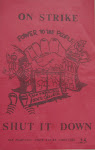
“On strike, shut it down!”
In 1968-69, African American, Asian American, Chicano and Native American students at San Francisco State College and
The concept "
Strike tactics involved informational picketing, blocking of campus entrances, mass rallies and teach-ins. Popular support was often met with repression in the form of police arrests, teargas and campus disciplinary actions. Police mutual assistance pacts enabled the rapid formations of riot squads dispatched from throughout the SF Bay area. During the Fall and Spring semesters of 1968-9, hundreds of students were arrested during the SF State strike, including more than 450 on one sweep alone. Similarly, over 155 students were arrested at the UC Berkeley strike which lasted the entire Winter Quarter of 1969. In the last two weeks of the dispute, the UC campus witnessed the stationing of National Guard troops to maintain martial law.
Establishment of ethnic studies programs has been one of the chief legacies of the strike. These programs have expanded nationally in over 250 universities, colleges and high schools. Both UC Berkeley and SF State University provide undergraduate and graduate degree programs in Ethnic Studies. Another important legacy of the strikes involved the establishment of closer working relationship between students and community. The post-TWLF era witnessed large numbers of Asian American students becoming involved in community-based organizing efforts within the Asian American movement. The International Hotel anti-eviction movement and the establishment of community centers in San Francisco Chinatown-Manilatown and Japantown were an outgrowth of this legacy.


CSC MONSOON MERCURY
Chinese Students’ Club
510 Eshleman Hall
Rally Postponed
"The AAPA Rally, scheduled for Sunday, June 30, in 155 Dwinelle Hall was cancelled due to the Campus and City curfews enacted in reaction to the demonstrations and violence of Friday and Saturday. The Dean’s office has told us that they would do all they could to re—schedule the event. All the speakers were notified in advance, and to those who came and were “repelled”, the AAPA offers its apologies and thanks, and asks those people to continue following or joining the
The Alliance is now selling “Yellow Peril” buttons to all, and “AAPA” buttons (with the Oriental character meaning ‘East’) to sympathizers and members. The AAPA plans to set up a table at noon in
--Floyd Huen
BLOG NOTE: On June 30, 1968: Berkeley mayor Wallace Johnson declares a state of emergency and a three day curfew in the city in response to violence in the wake of student demonstrations in support of French student and worker uprisings in France the previous month.
Photo: SFSU TWLF Strike Picketline (AAPA Newspaper 1969)TWLF SF
1. That a School of Ethnic Studies for the ethnic groups involved in the Third World be set up with the students in each particular ethnic organizations having the authority and control of the hiring and retention of any faculty member, director, and administrator, as well as the curriculum in a specific area of study.
2. That 50 faculty positions be appropriated to the
3. That in the Spring semester, the College fulfill its commitment to the non-white students by admitting those that apply.
4. That in the Fall of 1969, all applications of non-white students be accepted.
5. That George Murray and any other faculty person chosen by non-white people as their teacher be retained in their position.
(George Murray was an English Department lecturer who was dismissed for his participation in the Black Panther Party. SF State Strike Committee. On Strike: Shut It Down. 1968. p. 3.)
Photo: SFSU TWLF Strike Picketline (AAPA Newspaper 1969)INTERCOLLEGIATE CHINESE FOR SOCIAL ACTION
"S. F. State, a community college, exists in a moral vacuum, oblivious to the community it purports to serve. It does not reflect the pluralistic society that is
1. S. F. State has a Chinese language department that isolates the “Chinese Experience” as a cultural phenomenon in language that 83% of the Chinese in the
2. Chinatown is a ghetto in
“Statement of the Philippine-American Collegiate Endeavor (PACE) Philosophy and Goals.” Mimeograph excerpt. PACE was founded in 1967 at SFSU.
“We seek…simply to function as human beings, to control our own lives. Initially, following the myth of the American Dream, we worked to attend predominantly white colleges, but we have learned through direct analysis that it is impossible for our people, so-called minorities, to function as human beings, in a racist society in which white always come first…So we have decided to fuse ourselves with the masses of Third World people, which are the majority of the world’s peoples, to create, through struggle, a new humanity, a new humanism, a New World Consciousness, and within that context collectively control our own destinies.”