Showing posts with label SFSU Strike 1968. Show all posts

Thursday, January 17, 2008

Third World Student Strikes at SFSU & UCB 1968-1969

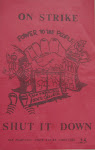
“On strike, shut it down!”

In 1968-69, African American, Asian American, Chicano and Native American students at San Francisco State College and University of California, Berkeley organized campus coalitions known as the Third World Liberation Front (TWLF). TWLF led student strikes demanded the establishment of Third World Colleges comprised of departments of Asian American, African American, Chicano and Native American Studies. Significance of these strikes were twofold: first, minority student were able to unite in solidarity against institutional racism and second, the strikes won the formation of Ethnic Studies programs.

The concept "Third World" provided a common basis of unity for the TWLF student activists. The term identified parallel colonial and racial experiences of minorities throughout US history. Examples of common racial oppression included: genocide of the native Indians, enslavement of Africans, colonization of Chicanos in the Southwest, and the passage of Asian immigration exclusion. This past was linked with the history of Western colonization in the Third World countries of Asia, Africa and Latin America. The international movements for independence and self-determination in those locales were viewed as related to the demands of U.S. Third World minorities for political power.

Strike tactics involved informational picketing, blocking of campus entrances, mass rallies and teach-ins. Popular support was often met with repression in the form of police arrests, teargas and campus disciplinary actions. Police mutual assistance pacts enabled the rapid formations of riot squads dispatched from throughout the SF Bay area. During the Fall and Spring semesters of 1968-9, hundreds of students were arrested during the SF State strike, including more than 450 on one sweep alone. Similarly, over 155 students were arrested at the UC Berkeley strike which lasted the entire Winter Quarter of 1969. In the last two weeks of the dispute, the UC campus witnessed the stationing of National Guard troops to maintain martial law.

Establishment of ethnic studies programs has been one of the chief legacies of the strike. These programs have expanded nationally in over 250 universities, colleges and high schools. Both UC Berkeley and SF State University provide undergraduate and graduate degree programs in Ethnic Studies. Another important legacy of the strikes involved the establishment of closer working relationship between students and community. The post-TWLF era witnessed large numbers of Asian American students becoming involved in community-based organizing efforts within the Asian American movement. The International Hotel anti-eviction movement and the establishment of community centers in San Francisco Chinatown-Manilatown and Japantown were an outgrowth of this legacy.

Wednesday, January 16, 2008

San Francisco State Strike 1968 TWLF Demands

Photo: SFSU TWLF Strike Picketline (AAPA Newspaper 1969)

TWLF SF State College Student Demands:

1. That a School of Ethnic Studies for the ethnic groups involved in the Third World be set up with the students in each particular ethnic organizations having the authority and control of the hiring and retention of any faculty member, director, and administrator, as well as the curriculum in a specific area of study.

2. That 50 faculty positions be appropriated to the School of Ethnic Studies, 20 would be for the Black Studies Program.

3. That in the Spring semester, the College fulfill its commitment to the non-white students by admitting those that apply.

4. That in the Fall of 1969, all applications of non-white students be accepted.

5. That George Murray and any other faculty person chosen by non-white people as their teacher be retained in their position.

(George Murray was an English Department lecturer who was dismissed for his participation in the Black Panther Party. SF State Strike Committee. On Strike: Shut It Down. 1968. p. 3.)

San Francisco State Strike 1968 Student Brochure

Photo: SFSU TWLF Strike Picketline (AAPA Newspaper 1969)

INTERCOLLEGIATE CHINESE FOR SOCIAL ACTION

"S. F. State, a community college, exists in a moral vacuum, oblivious to the community it purports to serve. It does not reflect the pluralistic society that is San Francisco--it does not begin to serve the 300, 000 non-white people who live in this urban community in poverty, ignorance, despair. The Chinese ghetto, Chinatown, is a case in point.

1. S. F. State has a Chinese language department that isolates the “Chinese Experience” as a cultural phenomenon in language that 83% of the Chinese in the U. S. don’t speak. Realistically, we can expect that a Chinese woman living in the ghetto, who speaks Cantonese, cannot explain to the scholar that she is dying of tuberculosis because she speaks a “street language” while the scholar mutters a classical poetry in Mandarin. S. F. State does not teach Cantonese.

2. Chinatown is a ghetto in San Francisco, there are approximately 50,000 Chinese of whom the vast majority live in Chinatown. It is an area of old buildings, narrow streets & alleys, and the effluvia of a great many people packed into a very small space. At present, more than 5, 000 new Chinese immigrants stream into this overpopulated ghetto each year, an area already blessed with a birthrate that is rising, and will rise more. Tuberculosis is endemic, rents are high and constantly rising, city services are inadequate to provide reasonable sanitation, and space is at such a premium as to resemble the Malthusian ratio at in most extreme. There are no adequate courses in any department of school at S. F. State that even begin to deal with the problems of the Chinese people in their exclusionary and racist environment."

Philippine-American Collegiate Endeavor (PACE)

“Statement of the Philippine-American Collegiate Endeavor (PACE) Philosophy and Goals.” Mimeograph excerpt. PACE was founded in 1967 at SFSU.

“We seek…simply to function as human beings, to control our own lives. Initially, following the myth of the American Dream, we worked to attend predominantly white colleges, but we have learned through direct analysis that it is impossible for our people, so-called minorities, to function as human beings, in a racist society in which white always come first…So we have decided to fuse ourselves with the masses of Third World people, which are the majority of the world’s peoples, to create, through struggle, a new humanity, a new humanism, a New World Consciousness, and within that context collectively control our own destinies.”

SFSU TWLF Strike Injuries from Police Brutality

Strike at frisco state! Pamphlet by Research Organizing Cooperative of San Francisco

Statistics gathered by doctors on injuries to arrested San Francisco State strikers (and innocent bystanders) inflicted by police, between December 2, 1968 and January 30, 1969. pg.31

NUMBER TYPE OF INJURY

1 Ruptured spleen (removed)

2 Fractured skull

2 Concussion

15 Forehead, skull lacerations

3 Nose broken, bloodied

1 Fractured eye orbit

7 Eyes maced

2 Other eye damage (e. g., black)

6 Facial lacerations, swelling

18 Other head damage (bump, swelling, contusion)

8 Stomach badly clubbed, scratched or kicked

2 Broken, contused, fractured ribs

3 Broken fingers, thumb

1 Broken, fractured leg

1 Arm broken, fractured from surgery

1 Arm infected from surgery

1 Kidney infection

4 Other groin area damaged

2 Respiratory Infection

1 Contused lung

7 Other rib area damage (soreness)

12 Back, neck (clubbing, choking, welts, burns)

4 Blood vessel damage. mass1ve bruises only)

15 Hand, arm, foot, leg laceration, swelling, lumps

5 Limb, finger, toe sprain, wrenched, contused

13 General bumps, bruises, soreness only

1 Nausea

80 Total number injured arrestees (many had more than one injury)

These do not include: (1) injuries sustained between November 6 and December 1; (2) injuries not reported; and (3) injuries to people who were not arrested. There might well be more of the latter than there were injured arrestees; it is impossible to tell how many.