Showing posts with label Wei Min She. Show all posts

Friday, December 14, 2007

What is Wei Min She?


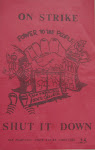
January 1971 Wei Min She, "Organization for the People" was formed out of the experience of the Asian Community Center.
"What Is Wei Min She?" is a handout written in 1971 explaining the organization.

"WHAT IS WEI MIN SHE?
Wei Mm She is an Asian American anti-imperialist organization in the S.F. Bay Area. Our name means “organization for the people.” Our organization is committed to building an anti-imperialist, multi-national, revolutionary mass movement in this country. Our strategy is to build a united front movement of all who can be united against the system of imperialism, led by the working class. The system of imperialism is controlled by the small class of capitalists who own the majority of the world’s wealth, while everyone else must work to live. We see the system of imperialism as the root cause of oppression of workers, national minorities, students, and women. While it exploits workers and national minorities at home, imperialism oppresses and exploits the people of .the world. Since the end of WWII, the U.S. has become the most powerful power in the world. Its tentacles have reached out and seized political and economic control of the underdeveloped nations of Asia, Africa, Latin America and the Middle East.

In the last couple of years, we have seen US, imperialism on the decline. The rise of national liberation movements in the underdeveloped and oppressed nations have been kicking U.S. Imperialism out of their countries. Vietnam and other countries in Southeast Asia, Africa, the Middle East, and Latin America have cut off the ability of U.S. companies to make superprofits. In other parts of the world, the political and economic strength of the U.S. is being challenged by other capitalist nations in Europe and Japan. Competition with another imperialist power, the Soviet Union, has also weakened the U.S. position.

Because of the rising struggles and economic and resistance abroad, the U.S. has found itself in a vise, US .imperialists find that they cannot maintain their rate of profits. They are turning to the working class at home to insure the profits they lost abroad. Nationwide, the living standards of the people are being attacked in a thousand different ways. People are being confronted with work speedups, mass layoffs, elimination of protective work laws, cutbacks in social services, increased police terror in Third World communities, energy freezes and food shortages.

Immigrant and minority workers are being attacked even harder. Because of the economic crisis, the companies are coming out with all sorts of propaganda to prevent unity in the class. The recent wave of anti-alien propaganda in the news and the massive deportations of Mexicans in California are bringing back reminders from the past. In the 1890’s, when the capitalists no longer needed the labor of Chinese and when the workers’ movement was on the rise due to the depression, the employers put the blame for the economic crisis on the large influx of Chinese workers into the country. Hence, a misguided workers’ movement began to develop around the slogan, “The Chinese Must Go:” instead of “The System Must Go:” When the Chinese were kicked out or forced into hiding in the Chinatowns throughout the West, unemployment was not solved and economic depressions continued on.

Today, immigrant workers are kept unorganized and used as cheap pools of labor. They have little job protection and work the longest hours at the lowest pay. The present crisis only intensifies their exploitation even further. However, this does not mean that working people are not resisting. These attacks on the people‘s living standards have been met with a militant and ever growing anti-imperialist movement. People everywhere are fighting back. Together with the peoples of the world, the American people are uniting across national lines to begin building the struggle against imperialism.

The anti-war movement, the struggles for childcare, and the increasing numbers of strikes arid walkouts are powerful testimonies to this development. Asian American and other Third World people are fighting for our democratic rights arid against national oppression. The Lee Mah and Jung Sai organizing drives in the S. F. Chinese Community, the struggle for equal employment in N.Y. Chinatown arid the fight for Ethnic Studies at U. C, Berkeley are a few examples. As Third World people, we must fight both oppression as minorities and exploitation as working people. Not only must the struggle be taken to the Asian communities, it must also be linked-up with the overall struggle of the multinational working class against the system.

The development of the mass movement into one is key to building the United Front Against Imperialism. Through this united front, we can rally various sectors of the American people against this system which must exploit in order to survive.

In building this united front, Wei Min She is involved with these areas of work:
1) Building labor Struggles--building the movement of Asian workers to link up with the larger working class movement to be able to lead the fight against imperialism. We have had practical experience in building support for the Farah strikers, Farmworkers, Nam Yuen Restaurant Busboys walkout, Asia Garden Restaurant workers dispute, S.F. Gold garment factory organizing drive, and now, Jung Sai and Lee Mah,.
2) Student Organizing—fighting for ethnic studies and building the anti-imperialist student movement through various forms of student organizations.
3) Fighting For Democratic Rights--building a movement in the community around the issues of health, housing, education, equal employment etc.
4) Building the Friendship of the Peoples of U.S and the People’s of China_--through film programs on China, forums, and. U.S.-China.People’s friendship events such as the 1974 Friendship Fair and October lst Celebration.
5) Building the Struggle Against the Oppression of Women--forums, supporting struggles of working women on the job, building the fight for childcare, and. participation in initiating events such as International Women’s Day.

If you would like more information about our organization, please contact us at: Wei Min She c/o ACC 846 Kearny St. S.F.,CA. 94108"

Thursday, December 13, 2007

Tuesday, December 11, 2007

Learning from the Old Timers in ACC: 1974


Chinatown

Workers

1920-1930

Unemployment

Fight

Wei Min

article 1974


A page from the Revolutionary History of Chinese in S.F

“A Page from the Revolutionary History of Chinese in San Francisco” was written by an active participant in the revolu­tionary workers’ movement in the San Francisco Chinese Community during the 1920’s and 1930’s. This series focuses on the early struggle of the Chinese working people against unemployment and police repression, and for unity among all working people.

This is a translation of the original. Chinese text.

"HOLDING HIGH THE RED BANNER

The Chinese people in San Francisco through the influence and experience of the Chinese revolution had come to learn the Three People’s Principles and the Three Policies of Sun Yat-sen as the road to victory for the national democratic revolution in China. At the same time, the revolutionary young Chinese workers saw through the internal power struggle of the Kuomjntang (KMT) stationed in the U.S. They refused to be involved in such notorious activi­ties. In 1926, they independently or­ganized the Three People’s Principles Study Association located on the third floor of a building on Kearny Street. It was there that the “blue-sky, white-sun, red-earth flag (KMT flag) was raised for the first time in the Chinese community. In the same year, revolu­tionary Chinese students organized the Chinese Students Association. Members of both these organizations participated in the San Francisco anti-.imperia1ist movement and became the nucleus of the Chinese Revolution.

On April 27, 1927 after Chiang Kai-shek betrayed the Chinese Revolution and surrendered to imperialism and feudalism, the KMT in the U.S. openly spilt into the “left” and right factions. The ‘left” faction set up its own party headquarters and started its own daily newspaper, Kuomin Yatpo. on Sacramento Street. After Chiang Kai-shek and Wang Ching-wei factions acted collusion, Communist members in the left faction of the KMT…withdrew from the KMT. They independently organized the Chinese Anti-imperialist League and joined forces with the Three People’s Principles Study League and Chinese Student Association for the struggle.

After the failure of the Canton Commune in 1927, the Three People’s Principles Study League was changed into the Kung Yu Club (a worker’s club). From then on the revolutionary movement of the San Francisco Chinese took great strides forward, and wrote a brilliant and glorious page in the history of revolutionary Chinese in America.

A MOVEMENT AGAINST UNEMPLOYMENT

In 1929, the United States sank into an economic crisis of such enormous scale that it shook the entire capitalist world. The stock market collapsed. Enterprises and factories closed down in large numbers. Fields were allowed to lie idled. More than 5 million industrial and agricultural workers were thrown into lengthy unemployment, without any means of livelihood. The monopoly capitalist class, seeing the growing number of unemployed and, the increasing sharpening of class contradiction .and class struggle, used every means possible to suppress and to divide the working class, to destroy its unity.

They tried to prevent and to paralyze the heightening of its political consciousness. A favorite method was to use racial discrimination --minority workers in various trades were replaced with white workers - This occurred even in the lowly menial, jobs in laundries, hotels, and domestic households. The unemployment rate among the San Francisco Chinese in 1930 was over 4000, more than 25% of the SF Chinese population.

In the past, due to the lies of U.S. imperialism added to the strong age old influence of feudal family and class attitudes, the class consciousness of the Chinese workers in SF was not high. When they were faced with unemployment, they only blamed fate. Furthermore their attitude o worshipping the U.S. instilled in them many illusions about U.S. capitalism. Therefore, although they were personally suffering, they could not immediately take up the struggle against capitalism.

But, the revolutionary elements within the Chinese community had a historical task to carry out. They could not allow the Chinese laboring masses to continue to live in a world of fantasy. They had to organize the Chinese unemployed workers to heighten their class consciousness through education, to work together with the working masses of every race and nationality, to wage the class struggle and to fight unemployment. Thus, these became the tasks of the Kung Yu Club.

In the summer of 1930, unemployment in the U.S. grew even more serious. The Kung Yu Club, under the leadership of the revolutionary Trade Union Unity League, began to make speeches on the street corners to the masses to expose the contradictions in capitalism and the causes of unemployment; to argue against collaboration of classes; to point out the direction of struggle and the method to resolve the unemployment problem.

At the beginning, the audience was not numerous. (The police was contemptuous about the effectiveness of the of the Kung In Club speeches.)

Then the police were sent in to halt the speeches. Police used blocking traffic as a pretext to stop the speeches and to disperse the crowd.

But the speakers were not daunted by the show of force by the police. They stood their ground and insisted upon holding the meeting on the spot. They retorted to the police with such questions as: “why do you only let Christians spread Christianity on this spot? Why should we workers, who built this road, have no right to use it?’ Thus, the speakers exposed the pseudo-democracy, freedom of speech of U.S. imperialism. They pointed out that the reactionary government of the U.S. only protected the interests of the capitalist class and suppressed the working class. The propaganda team called out to the audience to support, to continue to fight unemployment, to struggle against the police, and to continue their propaganda work

One night in 1930, towards the end of April, while the Club’s propaganda team was making speeches on the streets, more than ten policemen appeared and violently dragged a speaker off the platform. Immediately a second speaker replaced him on the platform. Again, as he was dragged away, a third speaker instantly took his place. By then more and more people gathered around. When the masses saw how the police repeatedly dragged the speakers off, they showed their indignation and then began to demonstrate. Seeing that the situation was getting out of hand, the police arrested two speakers, took them to a lonely spot and then released them after giving them brutal beatings.

KMT COLLABORATES W/ U.S. IMPERIALISTS TO CRUSH THE UNITY OF WORKERS

After the unemployed workers propaganda team was beaten up by the police, a few from the Kung Yu Club began to waver under the police pressure. They felt that the club should not continue activities in the open. But the majority was against this defeatist viewpoint. They felt..that after the propaganda sessions and the struggle with the police, people’s political awareness had increased, and .thus conditions had been developed for further organization work. They decided to mobilize individuals with whom they had worked and to make home visits.

The objective was to seek out unemployed workers whose awareness was relatively higher, to patiently do educational work and to conscientious1y develop a group of leading.elements. After a period of difficult and careful work, more than ten such individuals were developed. Thus, together with members of the Kung Yu Club, they formed the core for the Unemployment Council Preparation Committee to fight unemployment.

A basement in the 800 block of Washington Street in SF was rented as an office for the Committee to register the unemployed. Through much investigation and registration of unemployed people, a greater understanding of the living conditions of unemployed people was attained. The Committee conducted political education on an individual basis. Unemployed workers were inspired to voluntarily ask to join the Unemployment Council.

After two months, more than a thousand workers had registered. When the capitalists heard of the growing number of unemployed workers registered with the Committee, they became worried at the growing strength of the organized masses and tried to come up with various methods to destroy the group. They collaborated with the U.S. General Branch of the Kuomintang (KMT-Chinese Nationalist Party) in the U.S.

The KMT sent special agents, gamblers, opium dealers, secret society hoodlums and the like to infiltrate the Unemployment Council Preparation Committee. The infiltrators never had any credibility in the Chinese community anyway, but they spread reactionary rumors to try to frighten and split the masses.

Some of the rumors were that if you joined the struggle against unemployment, the U.S. government would interfere…that you would have difficulty finding a job in the future and run the risk of being deported. Another rumor was that white workers were using Chinese workers and the fruit gained in the struggle would be reaped by white workers only. The KMT spread ideas like racial differences between white and Asian workers are primary and that there is no such thing as common class interests. They tried to crush the growing class unity of Chinese, white and other workers.

At first, no direct attacks were made against these reactionary elements. Instead, their reactionary words and deeds were collected and mass discussion groups were organized. Class analysis was used to help people to understand the true nature of’ these reactionary rumors. This led the people to want to get after the reactionary dogs who were spreading such rumors.

Later, when the people saw through the KMT conspiracy, they openly confronted the KMT and exposed the members as lackies of U.S. Imperialism who were sent into spy on and disrupt the revolutionary worker’s movement. The people became very angry. They isolated the KMT and finally expelled the reactionary agents in the Committee.

THE FOUNDING OF THE CHINATOWN UNEMPLOYMENT COUNCIL

After the failure of the disruptive infiltration of U.S. imperialists and the KMT, the capitalists adopted open repressive measures. Police were sent to search the homes of several leaders of the Committee. They used the pretext that “non-U.S. citizens were participating in political activities in violation of the U.S. Constitution.” They arrested the leaders, hoping this tactic would intimidate the Preparation Committee members and halt the further development of the U.S. workers movement.

But the arrest of the leaders only led the masses to greater militancy. Other people on the Preparation Committee became more active and further developed the movement. More and more workers joined the Committee.

Two weeks after the leaders were jailed, the International Labor Defense freed them on $2,000 bail while they were awaiting trial. When the leaders returned to the office of the Unemployment Council Preparation Committee, there were already more than 2,000 unemployed workers who had registered with the Committee. The founding of a Chinatown Unemployment Council then became a central task.

In the autumn or winter of 1930, after planning for more than ten days, the Great China Theater was rented for the founding ceremonies. On the day of the event, employed and unemployed Chinese workers alike enthusiastically participated. The auditorium was completely packed. People who came late had to stand shoulder-to-shoulder in the aisles. The workers’ class spirit was high.

Sgt. Manion, the head of the Chinatown Detail Squad, made a special trip to the theater to spy on the proceedings, intending to disrupt them. But the number and support of the people at the ceremony was enormous. Also, there was tight security by the Committee, so the Sergeant could never make any move.

With the founding of the Chinatown Unemployment Council, the KMT saw that Chinese workers were rising up and casting away KMT influence to wage. a determined struggle against U.S. imperialism. The KMT was very worried and immediately started disruptive actions.

The KUO MIN YAT PO of the Wang Ching-wei clique published a short editorial attacking the Unemployment Council as being “controlled by communists who wanted to exploit the situation for their own gains.” This angered Unemployment Council members as well as people outside the Council. The Standing Committee immediately called a meeting of the representatives. The participants unanimously condemned and exposed the evil and disruptive designs of the KMT. They accused the KMT of selling-out the national interest or China by collaborating wth the imperialists and feudal forces, murdering workers and oppressing the people.

At the same time, the KMT abroad was accused of collaborating with U.S. imperialism against the welfare of overseas Chinese and especially workers. The KMT adopted an attitude of casting stones at the victim after he fell into a well.

The representatives at the meeting were indignant. They unanimously passed a resolution to send representatives to KUO MIN TAT PO to protest and to demand a public apology. Under the mass pressure, the newspaper had no choice but to accept the demands of the Unemployment Council and publish a public apology.

Through this struggle, the concrete experience of mass action, helped to clearly understand the reactionary nature of the KMT. At the same time it heightened the class consciousness of the masses in recognizing the absolute necessity to struggle against the enemy and in strengthening their confidence in victory.

(KUO MIN YAT PO – CHINESE DAILY, a newspaper originally started by the ‘left’ faction of the KMT, but later fell into the hands of the reactionary wing.)"


"How did the National Unemployed Council form?

MR. WONG: It was led by the Communist Party and the left. It was they alone among the Americans who accepted Chinese. After the big Hunger March, Chinese workers participated in a contingent in MAY DAY celebrations every year. MAY DAYS involved Spanish and Italians as well as other workers.

What were some of the slogans that you remember of the MAY DAYS?

MR LEE: The main thing then was “ORGANIZE THE UNORGANIZED”. At that time there was a union leader, Tom Mooney. The police put him in jail for 20 years until he got freed. And there was a big campaign to “Free Ton Mooney”. This issue was taken up by all working people across the country.

MR. WONG: One of the slogans was ‘WQRK OR WAGES’. Other issues raised during the MAY DAY’s were: “FIGHT AGAINST IMPERIALIST WARS. SUPPORT COLONIAL PEOPLES’ STRUGGLES, DEFEND THE SOVIET UNION—the only workers state which has now turned capitalist, and the fight for jobs, housing, and against speedups and lay-offs. Also the campaign to free Tom Mooney and the Scottsboro Boys-9 black youths falsely accused of rape. It was an international campaign led by the left to free them. Chinese workers saw that this oppression on minorities was similar to that in Chinatown. Chinese knew they must link up with others.

Last year both of you participated in the MAY DAY celebration held in Oakland. How do you feel about building for this year’s MAY DAY?

MR. LEE: Well, it won’t be hard to get support. Now you’ve got the Jung Sal workers’ support, the Lee MAH workers’ support. What we’ve seen in the last year was a great year—a big year. We leaned from the Jung Sai and Lee MAH workers. We can see from International Women’s Day. It was held in so many places. We can join up with people outside of Chinatown. We can also have a celebration in the Chinese Cultural Center and have a sound truck go around Chinatown.

MR. WONG: Last year’s MAY DAY (at San Antonio Park, Oakland) of about 1,000 is the biggest in the Bay Area since the 1930’s. Because of inflation and unemployment, we must unite and fight the growing fat on the capitalist. Hunger is not the only problem. We must see all the struggles as linked. We need to emphasize on housing, health, and education; and the working class to take the lead as the strongest class. Also we should point out the struggle between the two imperialist powers (the U.S. and the Soviet Union. Ed.) and the possibility of another world war.

Why do you think it’s so important that workers and other people in Chinatown know about MAY DAY and help build it?

MR. LEE: MAY DAY is the biggest day of the year. It’s a working people’s day. If we didn’t have that, how would we have the 8-hour day? See what we have today? A lot of people fought and gave their lives for that. You can see in China, it’s a people’s government. Over here we are oppressed every day, like people can’t find jobs; prices are high, no education, many things are disappointing for us. That’s why we have to fight—everyday! You know a lot of old -people after they retire, don’t participate in anything. I think old people should take part in the work. To build revolution, you have to work to the last day!"

Friday, December 7, 2007

CONFUCIANISM AND WOMEN, Wei Min Bao July1974

WEI MIN BAO July-August 1974 Vol. 3 No. 8

Confucianism and Asian Women, pg.6

EDITOR’ S NOTE:

The following is the second of two articles on Confucianism and Asians in America. (See WMB June, 1974 for part one) Recent developments both at home ( the fighting back of working people of all nationalities against their exploitation) and abroad (the growing struggles of peo­ples of Africa and Asia, for example; against feudalism, Imperialist exploita­tion and oppression) have created a situ­ation which demands that we Asian Ameri­cans critically look at our feudal Con­fucian heritage.

We must understand that the Confucian thinking we were taught--with its rules such as passive obedience to authority and maintaining harmony at any cost-- that this kind of ideology has obstruct­ed our full and active participation in changing American Society for the better.

This second part is a compilation of some of the experiences of many older Asian women. Their real experiences clearly reflect the sometimes subtle but most often blatant lnequality suffered by women as a result of Confucian ideology.

The current struggles of Asian elect­ronics and garment workers here in San Francisco Chinatown are showing that women are important and vital, indeed, in participating in and leading struggles for all of us.

DUTY OF WOMEN UNDER CONFUCIAN TRADITION

Not too long ago at a local graduation ceremony, a middle-aged Asian couple sat watching as their son was awarded a col­lege degree. Clearly proud of this accomplishment on the part of his son, the man turned to his wife beside him as if to mark the momentous occasion at hand and said, “Wife, you have done well. In the 26 years of our marriage, you have succeeded in bringing honor to our family. Not only have you managed our household, but more importantly, you have produced two fine sons, the second of whom has aldo brought honor to our family.”

Our Confucian upbringing taught us that as women our goal in life was to marry and bear sons. How many Chinese Americans re­call the elaborate ceremony which took place when a male child was born, such as the countless eggs dyed red and given to friends and relatives who came to congratulate the father. Because according to Confucian tradition, males counted--not females.

There are many among us who have heard the countless praises heaped upon our brothers when they did anything well such as get good grades or win an award. And of us females, why we were lucky if we were even noticed (and then we were inevitably asked as we grew older, “When are you getting married?”).

Some of us have heard our fathers, when hard-pressed. to say something about our mothers, talk on]y of their kitchen abilities. For example; one phrase heard is, “My wife, why she has leaned to do the most important thing in her life--and that is to cook well !”

CONFUCIAN ETHICS AS IT RELATES TO WORKING WOMEN.

Confucian ideology demanded that females be subservient to males. In fact, the roles that females had were defined according to their relationships to males: As daughters (to their fathers), as wives {to their hus­bands). and as mothers (to their sons). Therefore, women were expected to perform those tasks which reflected their positions within the family. A good daughter was one who learned at an early age how to cook, clean, sew and mend. She learned that her brothers always came first. So if the family could not afford to send both her brothers and herself to school, she was the one who had to stay home, (“Girls don’t need an education, they need a hus­band.”)

Many older Asian women never even went to high school. Our responsibility was clear­ly defined to us: to take care of our husbands and children. And when our hus­bands had a hard time earning enough to support the family (which was often the case) we shared the burden by working outside as well. But with our limited education and skills, we were forced to seek jobs which reflected the kinds of thing we had leaned to do at home-- wash, cook, sew, etc. So we found our­selves employed as domestics, as cooks, waitresses, and as garment workers.

Many older Asian women never even went t high school. Our responsibility was clearly defined to us: to take care of our husbands and children. And when our husbands had a hard time earning enough to support the family (which was often the case) we shared the burden by working outside as well. But with our limited education and skills, we were forced to seek jobs which reflected the kinds of thing we had leaned to do at home-- wash, cook, sew, etc. So we found ourselves employed as domestics, as cooks, waitresses, and as garment workers.

Today .the majority of older Asian women remain in these jobs, which are low-paying and low-skilled, trying to help or totally support our families. Of course, our responsibilities to our families still exist after we have put in a work shift. We are still expected to do all the household chores and to take care of our children. Our mothers are the ones we remember the most from our childhood, Of course, our fathers were there; too; but it was a feeling of fear we remember feeling toward them because they were the stern disciplinarians at home. Our mothers were the ones we turned to for affection and compassion; perhaps they, too, were a little afraid of our fathers as well.

OPPOSE BACKWARD AND WRONG THINKING.

There is an old Chinese saying that “If you marry a dog, you follow a dog.” That meant that you always had to obey your husband no matter what kind of person he was. A wife had to respect and subordinate herself to her husband; she could not demand the same respect and consideration from him in return. As Asian women brought up in a Confucian tradition, we have many barriers of feudal thinking and habits which we must recognize and counteract. First, we must reject the notion that our ideas are not as good as those of men; that we must rely on them to always take the lead and make decision. (its an unfair responsibility for men to have to always decide.)

We must also stop thinking that we can only do things which relate to our homes and children. The home is not our only sphere of activity. We are also workers facing the same, if not worse, job conditions that our husbands work under. We cannot sit idly by when working people fight for decent wages and better working conditions. Those struggles are ours, too.

We must take ourselves and our responsibilities seriously if we expect others to do so as well. But that does not mean that we separate ourselves from men and think that they are responsible for our low esteem and status in society. Men, too, have been taught the same Confucian virtues and values that we women learned. Neither one of us can combat our Confucian thinking alone. Together we must work to oppose this ideology which looked back to the past and not ahead to the future; which promoted and maintained inequalities among people; which favored the interests of the few over those of the many; and which taught that to know one’s “place” was the highest virtue and good.

Instead we must see that we, too, have played and continue to play an important role along with men in building this society. That together as equals we can work toward making this an even better and truly equal society for all people.

Tuesday, November 6, 2007

A Wei Min Sister


I was invited to write down some of my memories of my involvement as a woman in the Asian American Movement. I decided to do it because there is so little written about the Asian Community Center and Wei Min She (Organization for the People) both of which were an important part of the leftist movement in San Francisco Chinatown and the Bay Area during that time period.

“Women’s Oppression Impacted My Life”

Women's oppression had a big impact on how I developed as a person. I wasn’t conscious of it at the time. And in fact, when I first heard the term “women’s oppression”, I didn’t think it applied to me. How am I oppressed as a woman? “I was free to be and do what I wanted” was the belief I had. In 1970 I went to one of the first Women’s Day celebrations in the Bay Area. But I did not fully grasp at that time how important it was to take on the women’s question. Only now, looking back, women’s oppression should have been one of the initial causes of why I became involved with the radical movement in the 1970’s. Also, it was my own experience of women's oppression that is behind the reason why I never had the confidence to step forward to make even more of a difference during that time of widespread turmoil and activism.

I not only did not see myself as a leader, but also shied away from that role. One of the most vivid examples of this was during a trip to Canada in the early 70’s to attend a Women’s Conference that presented women speakers from Vietnam. This was an important international conference to build opposition to the Vietnam War and expose the atrocities that were being committed by the U.S. military. There was a bus load of women from the San Francisco Bay Area and other West coast cities that went to the conference. For the final day of the conference, the women voted for a representative to read a statement that would put forward their stand with the struggle of the Vietnamese people and oppose imperialism. I got the most votes because I was a member of the respected Wei Min She organization. But I was too timid to speak in front of an audience and declined, letting the second runner-up take my place. Even a woman from I Wor Kuen tried to struggle with me to do it, since I would also represent the Asians from the U.S. who were there (the runner-up was not Asian.) Needless to say, people from Wei Min She were not happy with me when I got back. Not being proud of my action, I avoided speaking about my trip to Canada even though it was such an important event. But I think my bringing it up here, in the context of talking about women's oppression, makes a good illustration of how oppression can suppress a person, preventing the full development of an individual's abilities and as a contributing member of a society or cause.

Women’s oppression impacted my life. It also impacted my life through how it influenced my mother’s life.

My mother came to the United States on a boat from China at the age of 22, just married to my father, and pregnant with her first child. My father had gone to China after World War II under the War Brides Act. On arriving in China, my father was introduced to two young women, and of the two, he picked my mother to marry him. She would have two more pregnancies after that, each one year apart. The third one was me. So here she was, in a new country, couldn’t speak the language, with very little money, and three babies. What a scary situation. My father wasn't around much in those days since he was going to school on the GI Bill and working at night at various jobs such as janitor or washing dishes and cleaning up at restaurants.

Fortunately, she didn’t get pregnant again for another three years after that. But all the stress of having and taking care of three little babies must have been tremendous. This was quite common in Chinatown back in the 1950’s. People had big families back then. My mother ended up having a total of six children.

So this was the situation into which I was born. And from the very beginning was a disadvantage. I was the third child my mother gave birth to within three years. All three were born in the month of August, one year after the other. Looking back, after I took courses in Chinese Medicine, it became clear why my health was never very good. According to Chinese Medicine, after giving birth, a woman’s body becomes depleted of qi, blood, and other substances and needs to recuperate. A two or three year gap between children would be better for the health of the mother and children. But this is not what happens in real life. As a result, I was never very strong and had headaches all my life due in part to my mother having three pregnancies within too short a time period. A woman who is over-worked and depleted will not have enough qi and other vital substances to pass on to the next child for optimum health. Thanks to the women’s movement, women now have more control over reproduction, but there is the continuing struggle to keep the right for women to choose from being chipped away.

Another disadvantage was that I was born a girl into a Chinese family with traditional views on the value and role of women. Even though my father was politically progressive, both my parents placed more value on having boys over girls. This outlook was very typical of my parents' generation, much less of the many generations before theirs who lived under feudalism in China. I remember going out in Chinatown, when I was a little girl, and hear how some mothers would scold and call their daughters awful names. My mother used to point out how lucky I was that she didn't use those types of words on me. While my parents wanted me to have good grades in school, they didn’t expect me to go to a four year college like my brothers. What a shock it was to hear my father’s response to my applying to be admitted to S.F. State College. "Why would you want to do that?" my father asked me. He thought a two-year college was all I would need. Why waste the money? To lessen the pain I felt from his response, I excused him for it by being understanding of the financial pressure he was under, having four sons he wanted to put through college.

My mother’s treatment of me has never been very good because I was not a boy. I tried to explain this to my oldest brother a few times when we were adults, and he never believed me until one day he saw it for himself. My mother made soup for the family, and there were a number of bowls filled with soup on the table. I went over to get one and my mother said “No, those are for your brothers, go get your own.” My brother looked at me, and I said, ”See what I mean?” He understood then what I had been talking about. I was a second class citizen in my own family. It was unfair to be treated this way, but I understand that it was due to a cultural outlook that my parents grew up with in China. This was part of women’s oppression in Chinese traditional culture. Women were considered inferior to men, and women's role was to serve the men in the family. My mother was never able to break from this view of her role, and it is sad for me to see how much her interests in life is limited to the family. Mao’s China took on this oppression, liberating the women of China from this feudal outlook and even influencing the development of the women’s movement in the U.S. as well. Unfortunately, some of these gains for women in China were reversed after Mao’s death as the succeeding leaders in China embraced capitalism.

“I’m Going Too”

The 1960's was a time of social turmoil, both internationally and within the U.S. Countries in Africa, Asia, the Middle East, and Latin America were fighting for freedom from colonialism. In the U.S. people were marching and demonstrating for civil rights and the right of Blacks to vote and ending Jim Crow laws in the South. There was the Free Speech Movement on college campuses. There was the start of the Vietnam war and the anti-war movement. With the start of the Black Power movement, similar movements arose in the Latino, Native American, and Asian communities. Militant groups like the Black Panther Party and Brown Berets developed across the country. San Francisco State College (now university) was one of the hot spots for the Free Speech Movement and the site of many demonstrations.

In 1968, I was 18 years old and it was my first semester at S.F. State. That semester, the first Third World Strike broke out. Among the demands were that education should be relevant to the community. That college education should be made accessible for minorities and the poor. That colleges and education should not be geared to the interests of making profits for the corporations and the military-industrial-complex. There should be ethnic studies so minorities could know their own histories and learn how to be of service to their communities. This was my start in becoming active in S.F. Chinatown and the Asian American Movement. It was here that I walked my first picket line and signed up to tutor immigrant school children in Chinatown. But the leaders of the strike did not reach out to involve me further and I was too shy to approach them myself. My further involvement would come from another direction.

Since junior high school (now called middle school) I was pretty much a book-reading recluse. I would borrow books from the public library and read on many subjects, fiction and non-fiction. In particular, I read as much science fiction as I could find. My particular heroes back then included astronomers Copernicus and Galileo and physicist Marie Curie. My two older brothers were more socially active. They went to Boy Scouts, drum and bugle corps, joined a kung fu club on Jackson Street, and played sports with friends. I was not into joining in with these types of activities. All my time was spent going to school, reading, and studying in my room at home. But this was going to change. Around 1968 I heard my brothers talking about going to Leeway, a pool hall for youth, where there were people talking about Mao Tse-tung, the Black Panther Party and reading from Mao's Little Red Book. This was where the Red Guard Party would form. Later on, my brothers would bring one of the founders of the Red Guard Party, Alex Hing, to our home to meet our father. The Red Guard Party wanted someone to translate their leaflets into Chinese. My father agreed to help.

The Red Guard Party was modeled after the Black Panther Party. They recruited mainly street kids as members. My father was very progressive in his politics. He was against the war in Vietnam, supported revolutionary China, and was persecuted during the McCarthy era by the FBI for being a member of Mun Ching, a progressive youth organiztion in Chinatown that had disbanded in 1959 when they lost their club house. The government carried out their anti-communist investigation into the Chinese community for many years begining in 1949 with the birth of New China under Mao. One angle to attack the left and progressives in Chinatown was through how many Chinese immigrated to the U.S. During the years when the Chinese Exclusion Act was still in force, many Chinese came to the U.S. illegally as "paper sons." My father was harassed for years, and when a cousin of his "talked", it opened the door for the FBI to act. My father's citizenship was taken away even though he had joined the U.S. army to fight against fascism in World War II. He would have been deported to China except for the fact that the U.S. couldn’t deport him to a country they didn’t recognize. I remember my father's response to losing his citizenship, he said that it's alright because he would rather be "a citizen of the world." So my father had been politically active when he was a young man, and after the Black Pather Party formed in the Bay Area, he used to bring home copies of the Black Panther newspaper that he bought on the street. So it was no surprise that he would help translate for the Red Guards. My father would later also translate material for the Asian Community Center and Wei Min Newspaper. I was proud of him for his hard work. He would go to work all day, and when he came home, he would stay up late to do the translations. He continued to do this even after he had a heart attack.

When the Red Guards started a free breakfast program like the Black Panthers, I volunteered to help during the summer of 1969. It was run out of one of the clubs on Broadway Street. But my long term involvement in Chinatown as an activist would not be with the Red Guards, but with a group of students from Berkeley who would set up the Asian Community Center and Everybody’s Bookstore at the end of 1969.

I didn’t know these students from Berkeley since I went to S.F. State. But both my older brothers went to U.C. Berkeley and they got pulled into action like many others. Berkeley had a history of student activism on campus. In the late 60’s Berkeley really heated up with protests. There were teach-ins on the Vietnam War, anti-draft actions, the Third World Strike, People’s Park. In response, the national guards were sent in with tear gas and even fired shots into crowds. The first time I saw some of these Berkeley students was in a huge anti-war protest in 1969 that marched from downtown San Francisco to Golden Gate Park. My brothers were going to the march with a friend. When I said, “I’m going too.” they didn’t object and I went too.

There had been many demonstrations against the war in Vietnam and now I was in one myself. My family was against the war but had never taken part in protest before. Now I was actually in one. It was very exciting with so many people. Along the way, we came across the Asian Contingent and marched with it. They had their own banners and signs. They raised opposition to the war from an Asian perspective, one I never thought about before. They said the Vietnamese people were our brothers and sisters. That the U.S. military called the Vietnamese “gooks," and that was how the military saw all Asians. I was amazed that some of them spoke Chinese, in fact they spoke Sze Yup like my family did at home, and not Sam Yup (Cantonese). As the march approached Golden Gate Park, we saw some Black Panther Party members passing out pamphlets by Mao tse-tung and selling their newspaper. We stayed to hear speeches and finally had to leave since we had nothing to eat or drink.

Surrounded By Banned Books

One day my oldest brother was talking about how he and a number of other students at Berkeley had chipped in $50.00 each to open a bookstore. At the mention of “bookstore” I immediately said I want to go there to work. I loved to read and had always wanted to work in a bookstore or library and be surrounded by books. He said he would find out for me and that was how I ended going to Kearny Street where I attended my first meeting. I was quite shocked when I was asked to give my opinion. As I mentioned, I was pretty reclusive and did not talk much.

The meeting was held in the basement of the building next to the International Hotel, at what was once the United Filipino Association Hall, 832 Kearny St. This would be the first location of the Asian Community Center. Later, we would be evicted and we moved into one of the basements in the I-Hotel at 846 Kearny Street. The bookstore was named Everybody's Bookstore and was in a storefront in the I-Hotel. Staffing for ACC and the Bookstore would all be done by volunteers, there was no money to pay for staff. Originally, the Bookstore was in a very small space, the size of a room in a house. It had very few books in the beginning, some were in English and some in Chinese. Many of the pamphlets and books were from China. The source of the books was probably China Books. I wasn’t involved with buying books for the store, but there was only one possible source for books like Mao’s red book and other writings.

China Books was the only importer for books, posters, and records from China in our area. I had gone to China Books before with my father and a number of his friends who used to be Mun Ching members. It was considered subversive to go to China Books because it imported goods from the People’s Republic of China, which was not recognized by the U.S. government. The China the U.S. recognized was Chiang Kai-shek’s Republic of China located on the island of Taiwan. Chiang Kai-shek and the political party he led, the KuoMinTang had fled to Taiwan after the victory of Mao Tse-tung’s revolution in 1949. In fact Chinatown back then was polarized along the lines of supporting Mao’s communist China and Chiang’s KMT Taiwan. Back in the 1950’s when Mun Ching had their club house on Stockton Street, the KMT used to throw garbage in their doorway. Mun Ching had members who supported the People's Republic of China so they were accused of being "communist." So I remember I had gone to China Books with my father, and I was shown books that were stamped by custom officials with words indicating the material was “banned”. I didn’t quite understand the politics and what it meant at the time since I was young.

My second brother didn’t get involved in ACC. He worked with the International Hotel for a while and often hung around with two I-Hotel women friends. My mother was quite upset when he brought them home a few times, one friend holding his arm for a guide as she was blind. I had a good laugh over her disaproval. I think my mother was also upset that I started to get active and leave the house. "Mh nah ga!" - which meant "never staying home."

“What We Want. What We See. What We Believe”

The first time I went down the stairs to the basement was in December 1969. People were watching revolutionary movies and newsreels. The free community film showings was one of the first programs the Berkeley students set up. The newsreels were documentary shorts on things like the Black Panther Party. They showed movies like “Battle of Algiers” which depicted how the Algerian people organized to fight for liberation from the French. The film program was one of the ways to educate the people to become political and class conscious so they could organize themselves to change society. After ACC was officially formed in 1970, I would soon learn to run the projector myself, and help set up weekend movie shows. We often showed movies about revolution and films from China showing the struggle for socialism that came from sources in Canada, since Canada did have relations with China. I will never forget the time we showed "East is Red," a song and dance drama of the Chinese Revolution, one weekend. We showed it for a total of fourteen times and it was packed for each showing. There was so much emotional response from the audience. During one afternoon showing, when it came to a scene of a woman forced to sell her daughter in the movie, a woman in the audience started sobbing loudly. It was too dark to see who it was, but we wondered if something similar had happened in her family.

In the early days, many of the regulars who came down to the basement were elderly men. Later, people of all ages would come down, including grade-school children. Due to exclusion laws against the Chinese, many of the early immigrants could not bring family members to the U.S. The men grew old all alone, working here and sending money home to families in China. ACC became the daily hang out for many of these old men. Some supported Mao and China for the politics, and some out of pride seeing their home country strong. I spent much of my time in the 70's at ACC. At school, when I got involved going to meeings to discuss the very beginnings of the Asian American Studies program and the Asian Women's class, I was seen as someone coming from ACC.

At the Asian Community Center, we had meetings to discuss the center's aims and purpose. Many groups in those days had a program. The Black Panther Party had their Ten Point program. We wanted something of our own. After discussing the issues that plagued Chinatown such as the highest TB rate in the country, crowded living conditions, sweat shops and restaurants with low paying jobs, long working hours, we came up with “What We Want. What We See. What We Believe.”

WHAT WE SEE

We see the breakdown of our community and families.

We see our people suffering from malnutrition, tuberculosis, and high suicide rates.

We see the destruction of our cultural pride.

We see our elders forgotten and alone.

We see our Mothers and Fathers forced into meaningless jobs to make a living.

We see American society preventing us from fulfilling our needs.

WHAT WE WANT

We want adequate housing, medical care, employment, and education.

WHAT WE BELIEVE

To solve our community problems, all Asian people must work together.

Our people must be educated to move collectively for direct action.

We will employ any effective means that our people see necessary.

I learned a lot about radical politics in these meetings. One thing the Berkeley students raised was how to work together. We were going to work collectively. Everyone would have input on decisions. Another thing we decided was that we were going to base ACC on the working class, not the lumpen proletariat (street people) like the Black Panthers or the Red Guards. It was here that I became aware of different political lines between groups. People who had similar lines would be able to come together and do work, whereas people with different lines would not. The original group of students who formed ACC were all American born but was able to join with a group of Hong Kong born students shortly after. Later Wei Min She was formed as an organization to lead the work politically.

Eventually we started many “serve the people” programs such as: weekly film showings; the Food Program where we distributed government supplemental foods to pregnant women and young children; we put out a family newsletter; in the summer we had a Summer Youth Program for school age children with tutoring and field trips. We set up health screenings for TB and glaucoma for the community at ACC soon after we formed, and later helped organize health fairs with other Chinatown organizations at Portsmouth Square, the park located a block from the center. We took on housing issues such as improving conditions at the Ping Yuen housing projects in Chinatown and the International Hotel. We supported worker's struggles at restaurants, garment shops, and electronic factories.

There was so many areas of work that special work groups were set up at different times. There was labor, health, education, housing, the newspaper Wei Min Bao, the Bookstore, etc. We also set up study groups to carry out political education for ourselves and for the volunteers who were interested in working with us. We studied the writings of Mao Tse-tung and applied much of it to our work. We studied the current conditions in the world, in the U.S. and in Chinatown. We went out to the masses to investigate their situation and get their opinions. We tried to apply criticism and self-criticism as we summed up our work. We studied the writings of Marx, Engels, Lenin, and books on the revolution in China such as Edgar Snow's "Red Star Over China." We read the writings of Malcolm X, Che Guevara, Frantz Fanon and many others in search of the direction forward for revolutionary change. We set up classes to study the "the women's question," and "the national question." In the summer of 1971, historian Him Mark Lai gave a series of six lectures on "Chinese in America" at ACC.

ACC and Everybody’s Bookstore was also a part of a larger Kearny Street community. There was what was left of Manilatown, reduced from ten blocks to just the I Hotel, the barbershop, Mabuhay Restaurant and the pool hall across the street. There was the International Hotel’s fight against eviction which drew many people from the community and students from campuses to join in the struggle. There were various other organizations that rented space in the I Hotel throughout the 70's including Draft Help, the Garment Co-op, the Red Guard Party, Chinese Progressive Association, I Wor Kuen, and Kearny Street Workshop.

This period of time in my life was rich with experience and people. I learned to do things I never dreamed of doing before including leading group meetings and discussions. I changed from being timid to a community activist on the streets of Chinatown, selling newspapers, passing out flyers, and talking to people on the various issues we took up. We had such hopes then of revolution, of changing the world and all of the existing social relationships. We wanted a world without exploitation and oppression. Looking at the world now, there is still so much more work to be done.

A Wei Min Sister