Chinatown
Workers
1920-1930
Unemployment
Fight
Wei Min
article 1974
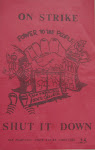
A page from the Revolutionary History of Chinese in S.F
“A Page from the Revolutionary History of Chinese in San Francisco” was written by an active participant in the revolutionary workers’ movement in the San Francisco Chinese Community during the 1920’s and 1930’s. This series focuses on the early struggle of the Chinese working people against unemployment and police repression, and for unity among all working people.
This is a translation of the original. Chinese text.
"HOLDING HIGH THE RED BANNER
The Chinese people in San Francisco through the influence and experience of the Chinese revolution had come to learn the Three People’s Principles and the Three Policies of Sun Yat-sen as the road to victory for the national democratic revolution in China. At the same time, the revolutionary young Chinese workers saw through the internal power struggle of the Kuomjntang (KMT) stationed in the U.S. They refused to be involved in such notorious activities. In 1926, they independently organized the Three People’s Principles Study Association located on the third floor of a building on Kearny Street. It was there that the “blue-sky, white-sun, red-earth flag (KMT flag) was raised for the first time in the Chinese community. In the same year, revolutionary Chinese students organized the Chinese Students Association. Members of both these organizations participated in the San Francisco anti-.imperia1ist movement and became the nucleus of the Chinese Revolution.
On April 27, 1927 after Chiang Kai-shek betrayed the Chinese Revolution and surrendered to imperialism and feudalism, the KMT in the U.S. openly spilt into the “left” and right factions. The ‘left” faction set up its own party headquarters and started its own daily newspaper, Kuomin Yatpo. on Sacramento Street. After Chiang Kai-shek and Wang Ching-wei factions acted collusion, Communist members in the left faction of the KMT…withdrew from the KMT. They independently organized the Chinese Anti-imperialist League and joined forces with the Three People’s Principles Study League and Chinese Student Association for the struggle.
After the failure of the Canton Commune in 1927, the Three People’s Principles Study League was changed into the Kung Yu Club (a worker’s club). From then on the revolutionary movement of the San Francisco Chinese took great strides forward, and wrote a brilliant and glorious page in the history of revolutionary Chinese in America.
A MOVEMENT AGAINST UNEMPLOYMENT
In 1929, the United States sank into an economic crisis of such enormous scale that it shook the entire capitalist world. The stock market collapsed. Enterprises and factories closed down in large numbers. Fields were allowed to lie idled. More than 5 million industrial and agricultural workers were thrown into lengthy unemployment, without any means of livelihood. The monopoly capitalist class, seeing the growing number of unemployed and, the increasing sharpening of class contradiction .and class struggle, used every means possible to suppress and to divide the working class, to destroy its unity.
They tried to prevent and to paralyze the heightening of its political consciousness. A favorite method was to use racial discrimination --minority workers in various trades were replaced with white workers - This occurred even in the lowly menial, jobs in laundries, hotels, and domestic households. The unemployment rate among the San Francisco Chinese in 1930 was over 4000, more than 25% of the SF Chinese population.
In the past, due to the lies of U.S. imperialism added to the strong age old influence of feudal family and class attitudes, the class consciousness of the Chinese workers in SF was not high. When they were faced with unemployment, they only blamed fate. Furthermore their attitude o worshipping the U.S. instilled in them many illusions about U.S. capitalism. Therefore, although they were personally suffering, they could not immediately take up the struggle against capitalism.
But, the revolutionary elements within the Chinese community had a historical task to carry out. They could not allow the Chinese laboring masses to continue to live in a world of fantasy. They had to organize the Chinese unemployed workers to heighten their class consciousness through education, to work together with the working masses of every race and nationality, to wage the class struggle and to fight unemployment. Thus, these became the tasks of the Kung Yu Club.
In the summer of 1930, unemployment in the U.S. grew even more serious. The Kung Yu Club, under the leadership of the revolutionary Trade Union Unity League, began to make speeches on the street corners to the masses to expose the contradictions in capitalism and the causes of unemployment; to argue against collaboration of classes; to point out the direction of struggle and the method to resolve the unemployment problem.
At the beginning, the audience was not numerous. (The police was contemptuous about the effectiveness of the of the Kung In Club speeches.)
Then the police were sent in to halt the speeches. Police used blocking traffic as a pretext to stop the speeches and to disperse the crowd.
But the speakers were not daunted by the show of force by the police. They stood their ground and insisted upon holding the meeting on the spot. They retorted to the police with such questions as: “why do you only let Christians spread Christianity on this spot? Why should we workers, who built this road, have no right to use it?’ Thus, the speakers exposed the pseudo-democracy, freedom of speech of U.S. imperialism. They pointed out that the reactionary government of the U.S. only protected the interests of the capitalist class and suppressed the working class. The propaganda team called out to the audience to support, to continue to fight unemployment, to struggle against the police, and to continue their propaganda work
One night in 1930, towards the end of April, while the Club’s propaganda team was making speeches on the streets, more than ten policemen appeared and violently dragged a speaker off the platform. Immediately a second speaker replaced him on the platform. Again, as he was dragged away, a third speaker instantly took his place. By then more and more people gathered around. When the masses saw how the police repeatedly dragged the speakers off, they showed their indignation and then began to demonstrate. Seeing that the situation was getting out of hand, the police arrested two speakers, took them to a lonely spot and then released them after giving them brutal beatings.
KMT COLLABORATES W/ U.S. IMPERIALISTS TO CRUSH THE UNITY OF WORKERS
After the unemployed workers propaganda team was beaten up by the police, a few from the Kung Yu Club began to waver under the police pressure. They felt that the club should not continue activities in the open. But the majority was against this defeatist viewpoint. They felt..that after the propaganda sessions and the struggle with the police, people’s political awareness had increased, and .thus conditions had been developed for further organization work. They decided to mobilize individuals with whom they had worked and to make home visits.
The objective was to seek out unemployed workers whose awareness was relatively higher, to patiently do educational work and to conscientious1y develop a group of leading.elements. After a period of difficult and careful work, more than ten such individuals were developed. Thus, together with members of the Kung Yu Club, they formed the core for the Unemployment Council Preparation Committee to fight unemployment.
A basement in the 800 block of Washington Street in SF was rented as an office for the Committee to register the unemployed. Through much investigation and registration of unemployed people, a greater understanding of the living conditions of unemployed people was attained. The Committee conducted political education on an individual basis. Unemployed workers were inspired to voluntarily ask to join the Unemployment Council.
After two months, more than a thousand workers had registered. When the capitalists heard of the growing number of unemployed workers registered with the Committee, they became worried at the growing strength of the organized masses and tried to come up with various methods to destroy the group. They collaborated with the U.S. General Branch of the Kuomintang (KMT-Chinese Nationalist Party) in the U.S.
The KMT sent special agents, gamblers, opium dealers, secret society hoodlums and the like to infiltrate the Unemployment Council Preparation Committee. The infiltrators never had any credibility in the Chinese community anyway, but they spread reactionary rumors to try to frighten and split the masses.
Some of the rumors were that if you joined the struggle against unemployment, the U.S. government would interfere…that you would have difficulty finding a job in the future and run the risk of being deported. Another rumor was that white workers were using Chinese workers and the fruit gained in the struggle would be reaped by white workers only. The KMT spread ideas like racial differences between white and Asian workers are primary and that there is no such thing as common class interests. They tried to crush the growing class unity of Chinese, white and other workers.
At first, no direct attacks were made against these reactionary elements. Instead, their reactionary words and deeds were collected and mass discussion groups were organized. Class analysis was used to help people to understand the true nature of’ these reactionary rumors. This led the people to want to get after the reactionary dogs who were spreading such rumors.
Later, when the people saw through the KMT conspiracy, they openly confronted the KMT and exposed the members as lackies of U.S. Imperialism who were sent into spy on and disrupt the revolutionary worker’s movement. The people became very angry. They isolated the KMT and finally expelled the reactionary agents in the Committee.
THE FOUNDING OF THE CHINATOWN UNEMPLOYMENT COUNCIL
After the failure of the disruptive infiltration of U.S. imperialists and the KMT, the capitalists adopted open repressive measures. Police were sent to search the homes of several leaders of the Committee. They used the pretext that “non-U.S. citizens were participating in political activities in violation of the U.S. Constitution.” They arrested the leaders, hoping this tactic would intimidate the Preparation Committee members and halt the further development of the U.S. workers movement.
But the arrest of the leaders only led the masses to greater militancy. Other people on the Preparation Committee became more active and further developed the movement. More and more workers joined the Committee.
Two weeks after the leaders were jailed, the International Labor Defense freed them on $2,000 bail while they were awaiting trial. When the leaders returned to the office of the Unemployment Council Preparation Committee, there were already more than 2,000 unemployed workers who had registered with the Committee. The founding of a Chinatown Unemployment Council then became a central task.
In the autumn or winter of 1930, after planning for more than ten days, the Great China Theater was rented for the founding ceremonies. On the day of the event, employed and unemployed Chinese workers alike enthusiastically participated. The auditorium was completely packed. People who came late had to stand shoulder-to-shoulder in the aisles. The workers’ class spirit was high.
Sgt. Manion, the head of the Chinatown Detail Squad, made a special trip to the theater to spy on the proceedings, intending to disrupt them. But the number and support of the people at the ceremony was enormous. Also, there was tight security by the Committee, so the Sergeant could never make any move.
With the founding of the Chinatown Unemployment Council, the KMT saw that Chinese workers were rising up and casting away KMT influence to wage. a determined struggle against U.S. imperialism. The KMT was very worried and immediately started disruptive actions.
The KUO MIN YAT PO of the Wang Ching-wei clique published a short editorial attacking the Unemployment Council as being “controlled by communists who wanted to exploit the situation for their own gains.” This angered Unemployment Council members as well as people outside the Council. The Standing Committee immediately called a meeting of the representatives. The participants unanimously condemned and exposed the evil and disruptive designs of the KMT. They accused the KMT of selling-out the national interest or China by collaborating wth the imperialists and feudal forces, murdering workers and oppressing the people.
At the same time, the KMT abroad was accused of collaborating with U.S. imperialism against the welfare of overseas Chinese and especially workers. The KMT adopted an attitude of casting stones at the victim after he fell into a well.
The representatives at the meeting were indignant. They unanimously passed a resolution to send representatives to KUO MIN TAT PO to protest and to demand a public apology. Under the mass pressure, the newspaper had no choice but to accept the demands of the Unemployment Council and publish a public apology.
Through this struggle, the concrete experience of mass action, helped to clearly understand the reactionary nature of the KMT. At the same time it heightened the class consciousness of the masses in recognizing the absolute necessity to struggle against the enemy and in strengthening their confidence in victory.
(KUO MIN YAT PO – CHINESE DAILY, a newspaper originally started by the ‘left’ faction of the KMT, but later fell into the hands of the reactionary wing.)"
"How did the National Unemployed Council form?
MR. WONG: It was led by the Communist Party and the left. It was they alone among the Americans who accepted Chinese. After the big Hunger March, Chinese workers participated in a contingent in MAY DAY celebrations every year. MAY DAYS involved Spanish and Italians as well as other workers.
What were some of the slogans that you remember of the MAY DAYS?
MR LEE: The main thing then was “ORGANIZE THE UNORGANIZED”. At that time there was a union leader, Tom Mooney. The police put him in jail for 20 years until he got freed. And there was a big campaign to “Free Ton Mooney”. This issue was taken up by all working people across the country.
MR. WONG: One of the slogans was ‘WQRK OR WAGES’. Other issues raised during the MAY DAY’s were: “FIGHT AGAINST IMPERIALIST WARS. SUPPORT COLONIAL PEOPLES’ STRUGGLES, DEFEND THE SOVIET UNION—the only workers state which has now turned capitalist, and the fight for jobs, housing, and against speedups and lay-offs. Also the campaign to free Tom Mooney and the Scottsboro Boys-9 black youths falsely accused of rape. It was an international campaign led by the left to free them. Chinese workers saw that this oppression on minorities was similar to that in Chinatown. Chinese knew they must link up with others.
Last year both of you participated in the MAY DAY celebration held in Oakland. How do you feel about building for this year’s MAY DAY?
MR. LEE: Well, it won’t be hard to get support. Now you’ve got the Jung Sal workers’ support, the Lee MAH workers’ support. What we’ve seen in the last year was a great year—a big year. We leaned from the Jung Sai and Lee MAH workers. We can see from International Women’s Day. It was held in so many places. We can join up with people outside of Chinatown. We can also have a celebration in the Chinese Cultural Center and have a sound truck go around Chinatown.
MR. WONG: Last year’s MAY DAY (at San Antonio Park, Oakland) of about 1,000 is the biggest in the Bay Area since the 1930’s. Because of inflation and unemployment, we must unite and fight the growing fat on the capitalist. Hunger is not the only problem. We must see all the struggles as linked. We need to emphasize on housing, health, and education; and the working class to take the lead as the strongest class. Also we should point out the struggle between the two imperialist powers (the U.S. and the Soviet Union. Ed.) and the possibility of another world war.
Why do you think it’s so important that workers and other people in Chinatown know about MAY DAY and help build it?
MR. LEE: MAY DAY is the biggest day of the year. It’s a working people’s day. If we didn’t have that, how would we have the 8-hour day? See what we have today? A lot of people fought and gave their lives for that. You can see in China, it’s a people’s government. Over here we are oppressed every day, like people can’t find jobs; prices are high, no education, many things are disappointing for us. That’s why we have to fight—everyday! You know a lot of old -people after they retire, don’t participate in anything. I think old people should take part in the work. To build revolution, you have to work to the last day!"