Wednesday, January 16, 2008

Philippine-American Collegiate Endeavor (PACE)

“Statement of the Philippine-American Collegiate Endeavor (PACE) Philosophy and Goals.” Mimeograph excerpt. PACE was founded in 1967 at SFSU.

“We seek…simply to function as human beings, to control our own lives. Initially, following the myth of the American Dream, we worked to attend predominantly white colleges, but we have learned through direct analysis that it is impossible for our people, so-called minorities, to function as human beings, in a racist society in which white always come first…So we have decided to fuse ourselves with the masses of Third World people, which are the majority of the world’s peoples, to create, through struggle, a new humanity, a new humanism, a New World Consciousness, and within that context collectively control our own destinies.”

SFSU TWLF Strike Injuries from Police Brutality

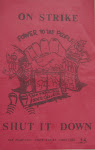
Strike at frisco state! Pamphlet by Research Organizing Cooperative of San Francisco

Statistics gathered by doctors on injuries to arrested San Francisco State strikers (and innocent bystanders) inflicted by police, between December 2, 1968 and January 30, 1969. pg.31

NUMBER TYPE OF INJURY

1 Ruptured spleen (removed)

2 Fractured skull

2 Concussion

15 Forehead, skull lacerations

3 Nose broken, bloodied

1 Fractured eye orbit

7 Eyes maced

2 Other eye damage (e. g., black)

6 Facial lacerations, swelling

18 Other head damage (bump, swelling, contusion)

8 Stomach badly clubbed, scratched or kicked

2 Broken, contused, fractured ribs

3 Broken fingers, thumb

1 Broken, fractured leg

1 Arm broken, fractured from surgery

1 Arm infected from surgery

1 Kidney infection

4 Other groin area damaged

2 Respiratory Infection

1 Contused lung

7 Other rib area damage (soreness)

12 Back, neck (clubbing, choking, welts, burns)

4 Blood vessel damage. mass1ve bruises only)

15 Hand, arm, foot, leg laceration, swelling, lumps

5 Limb, finger, toe sprain, wrenched, contused

13 General bumps, bruises, soreness only

1 Nausea

80 Total number injured arrestees (many had more than one injury)

These do not include: (1) injuries sustained between November 6 and December 1; (2) injuries not reported; and (3) injuries to people who were not arrested. There might well be more of the latter than there were injured arrestees; it is impossible to tell how many.

Tuesday, January 15, 2008

Asian American Political Alliance 1968

It was no accident that the Asian American movement began in Berkeley, California. – also the birthplace of the Free Speech Movement (FSM) at the University of California at Berkeley (UCB). Social activists worldwide were drawn to this center of the student and antiwar movement in the ‘60s. It was a couple—Yuji Ichioka, a UCB history grad student, and Emma Gee—both of whom were civil rights activists, who initiated a Peace and Freedom Party caucus by phoning every Asian-sounding name listed on Party petitions in the Berkeley/East Bay area.

In May 1968 those half-dozen or so who responded met in the Berkeley’s Northside Ichioka/Gee apartment – from then on affectionately referred to as “AAPA home” by its members, because that is how they felt when being around others like them for the first time. Unanimously they agreed to form an historic independent organization - the Asian American Political Alliance (AAPA). They quickly enlisted others; hammered out a program*; designed a logo, button and colors; worked out alliances; and boldly introduced itself to the public in July 1968.

AAPA was the first self-named group that called themselves “Asian American,” a term that Ichioka proposed. These AAPA founders, while young in age, were all political veterans from a wide range of experiences. And while most were UC Berkeley students, they never envisioned AAPA as a student organization but a much broader, all-inclusive, community grassroots alliance. Several had from their working class youths been involved with the United Farm Workers (UFW) and other labor organizing, while another was an Army veteran and Black Panther Party member, and all were involved in the ongoing civil rights/black power, anti-war and anti-poverty movement.

These AAPA founders also consciously and carefully chose “Political” and “Alliance” in the group’s name to distinguish itself from previous ethnic groups that had a more social and/or club-like connotation. They did this not to denigrate existing groups like the Japanese American Citizens League (JACL), whom AAPA respected and worked with on progressive issues, but to forge an openly anti-imperialist political organization for all Asian nationalities, one that could stand on an equal basis with the other dominant Third World groups at the time, as part of the international Third World liberation movement for self-determination.

The term “Asian American” quickly became a unifying force among the different Asian ethnic groups. AAPA chapters and other similarly self-titled Asian organizations rapidly spread throughout the US. AAPA opened an avenue of activism for many Asian Americans who later played vital roles in the social transformations of the period, including the Third World Liberation Front Strikes at San Francisco State College and UC Berkeley, the International Hotel tenants struggle, and the formation of Asian Studies and Third World College curriculums nationwide. Just as their Third World brothers and sisters had done, AAPA, as the Asian American expression of “Power to the People!”, enabled Asian Americans to rename, reclaim, redefine, and liberate themselves from oppression.


AAPA Rally July 28, 1968


Excerpts from a speech written by Richard Aoki for the AAPA rally July 28, 1968

“We Asian-Americans believe that American society has been, and still is, fundamentally a racist society, and that historically we have accommodated ourselves to this society in order to survive...

We’re sick and tired of being sick and tired of being sick and tired of relating to white standards of acceptability...We’re tired of hearing the racist chant about “if you’re white...” This has wreaked havoc upon our cultural identity...

At this point I would like to say a few words about the servant syndrome prevalent in this white racist society...As most of you know the typical Oriental is thought of as a servant (and dig--servants are not considered equals anywhere in time and place)...The Chinese are regarded as laundrymen (fit only for woman’s work), the Japanese are regarded as gardeners. the Filipinos are regarded as chauffeurs...

We are sick of being used by the white racist power structure... Don’t rock the boat...Used as an example...

We Asian-Americans support all non-white liberation movements and believe that all minorities in order to be truly liberated must have complete control over the political, economic and social institutions within their respective communities”.

We unconditionally, support the struggles of the Afro-American people, the Chicanos, and the American Indians in to attain freedom, justice and equality...

We Asian-Americans oppose the imperialist policies being pursued by the American government...

Professor Miyoshi has presented our views on the Vietnam war...We are unconditionally against the war in Vietnam...
some of us view the war as another one of white racist America’s trickbag….They are committing double genocide over there..Dig, if a black, brown or yellow brother is sent to Vietnam he is being sent to kill his yellow brother.. if the black, brown
or yellow brother kills the Vietnamese..Mr. Charley comes out ahead, and if the Vietnamese kills the black brown or yellow brother, Mr. Charley again comes out ahead...This is a classical case of heads I win, tails you lose...

In conclusion, I would like to add that the Asian-American Political Alliance is not just another Sunday social club. We are an action-oriented group, and we will not just restrict our activities to merely ethic issues, but to all issues that are of fundamental importance pertaining to the building of a new and a better world."

UC Berkeley Asian American 1969


Photos from AAPA Newspaper 1969

Monday, January 14, 2008

AAPA Retort to Agnew "fat jap" Comment 1968

Nixon~Agnew Retort 09-26-1968

"We must admit that vice—presidential candidate Spiro Agnew has kept his promise. His name is now a household word in the Japanese-American community.

The Asian—American Political Alliance vigorously protests the racist epithet, “fat Jap”, recently uttered by Agnew.

We must reluctantly concur with the Kerner Commission’s finding that “white racism” is the fundamental cause of civil disorders, and that “white racism” seems to have infected a person running for the second highest political office of this country.

We, as members of a racial minority, do not at all feel amused by racist type humor at our expense, or at the expense of any of our racial and ethnic brothers and sisters. We also feel that the so-called apology rendered afterward was wholly inadequate.

It is indeed a very sad commentary on white American culture to use pejorative terms in their relations with minority groups. It is also a sad commentary that Agnew appears to have such a low level of sensitivity as far as race relations are concerned. If the Republican party is victorious in November, we would humbly suggest to Nixon that he would refrain from sending Agnew on goodwill missions to the rest of the world with the exception of either Rhodesia or the Union of South Africa. (ed. note: in 1968, two apartheid countries)

Asian American Political Alliance


AAPA PERSPECTIVES October 1969


Reprinted from ASIAN AMERICAN POLITICAL ALLIANCE,

Vol. 1, No. 6, October, 1969. Berkeley, page 3.

AAPA PERSPECTIVES

“The Asian American Political Alliance is people. It is a people’s alliance to effect social and political changes. We be­lieve that the American society is histori­cally racist and one which has systematically employed social discrimination and economic imperialism, both domestically and interna­tionally, exploiting all non-white people in the process of building up their affluent society.

"They did so at the expense of all of us. Uncontrolled capitalism has pushed all of the non-white people into a social posi­tion so that only manual jobs with subhuman pay are open to them. Consequently, we have been psychologically so conditioned by the blue-eye—blond—hair standard that many of us have lost our perspective, We can only sur­vive if “we know our place”—-shut up and ac­cept what we are given, We resent this kind of domination and we are determined to change

"The goal of AAPA is political education and advancement of the movement among Asian people, so that they may make all decisions that affect their own lives, in a society that never asks people to do so. AAPA is not an isolated group, and should never pro­fess to be such. Its only legitimacy and value is in the effects it has on many people, not just a small group of people. In the same vein, AAPA is not meant to isolate Asians from other people; it is unhealthy as well as unwise to do such a thing. AAPA must con­stantly expand and grow, and reach out to other people and groups. At the same time, AAPA must meet the needs of its own members and deal with its own problems.

"In the past political organizations have tended to subject themselves to rigid, tradi­tional levels of structure in which a few make the decisions, present them to the body, and the body can vote either ‘yes” or “no.” This hierarchic organization, however, is only a manifestation of the elite control, primeval structure mentality in which you are not capable of making your own decisions, an idea drilled into you. from the foundations of this society.

"AAPA is only what the people make it. We have adopted a structure which better fits the needs and goals of our alliance, not a structure to which we have to adjust our­selves. Furthermore, there is no membership in AAPA in the strict sense of the word. There are workers who for common interests join together with one or more people to in­tensify the effectiveness of an action.

"Since May, 1968, AAPA has grown from a small group of students and community workers to a powerhouse for Asian thought and action. AAPA is now a member of the Third World Li­beration Front, Asian Association, and Asian Coalition. Some past activities of Berke­ley AAPA include: Free Huey Rallies at the Oakland Courthouse, Chinatown Forums, Mc­Carran Act lobbies, MASC Boycott, Third World Liberation Front Strike, development of Asian Studies, and liaison with and development of other AAPA’s throughout the state.


"AAPA is only a transition for develop­ing our own social identity, a multiplication of efforts. In fact, AAPA itself is not the important link but the ideas generated into action from it——that we Asian Americans are no longer going to kowtow to white America in order to gain an ounce of respect; that we must begin to build our own society along­side our black, brown and red brothers as well as those whites willing to effect funda­mental social, economic, political changes; that we have the right for determining our own lives and asserting our yellow identity as a positive force in a new life based on human relationships and cooperation.”

Sunday, January 13, 2008

Asians Unite! Antiwar Brochure 1969

Asians Unite! U.S. War in Southeast Asia.

Asians unite! Number 2

U.S. Leaders March to War: Memorable Quotes

“When I speak of the Pacific Rim, I am putting the broadest possible construction on the term—the western coasts of South America, Central America, and our own continent, and extending beyond Australia and the Far East to India. There is no more vast or rich area for resource development or trade growth in the world today than this immense region, and it is virtually our own front yard…I emphasize that this is a largely underdeveloped area, yet an area rich in an immense variety of resources and potential capabilities. Were we California businessmen to play a more dynamic role in helping trade development in the Pacific Rim, we would have giant, hungry new markets for our products and vast new profit potentials for our firms.”

Rudolf Peterson, President, Bank of America,

in California Business Magazine

September, October 1968


“Now the Pacific has become an Anglo-Saxon lake and our line of defense runs through the chain of islands fringing the coast of Asia. It starts from the Philippines and continues through the Ryuku archipelago which includes its broad main bastion, Okinawa. Then it bends back through Japan and the Aleutian Chain to Alaska.”

Douglas MacArthur, Supreme Commander of Pacific in 1949


“Examined dramatically, but more often quietly, the rest of Asia has been undergoing a profound, an exciting and on balance an extra-ordinarily promising transformation…In looking toward the future, however, we should not ignore the vital role Vietnam has played in making these developments possible. Whatever one may think of the ‘domino theory’, it is beyond question that without the American commitment in Vietnam Asia would be a far different place today…

This was vital factor in the turn around in Indonesia where a tendency toward fatalism is a national characteristic…And with its 100 million people and it’s 3,000 mile arc of islands containing the region’s richest resources. Indonesia constitutes by far the greatest prize in the South East Asian area…

The United States is a Pacific power. Europe has been withdrawing the remnants of empire, by the United States, with its coast reaching in an arc from Mexico to the Bering Straits, is one anchor of a vast westward across the Pacific…linked by the sea not only with those oriental nations on Asia’s Pacific litteral but at the same time with Occidental Australia and New Zealand, and with the island nations in between.”

Richard Nixon, 1967 writing in Foreign Affairs.


“The empire in Southeast Asia is the last major resource area outside the control of any one of the major powers on the globe…I believe that the conditions of the Vietnamese people, and the direction in which their future may be going, are at this stage secondary, not primary.”

Senator McGee (Wyoming) US Senate, 2-17-1965


“I am sure that the great American people, if only they knew the true facts and the background to the developments in South Vietnam, would agree with me that further bloodshed is unnecessary. However, in times of war and of hostilities the first casualty is truth.”

U Thant, Secretary General of the UN

February 25, 1965


“Now let us assume that we lost Indochina…the tin and tungsten that we so greatly value from that area would cease coming…So when the US votes 400 million dollars to help that war, we are not voting a give-away program. We are voting for the cheapest way to prevent the occurrence of something that would be of a most terrible significance to the United States of America, our security our power and the ability to get certain things we need from the riches of the Indochinese territory and from Southeast Asia.”

8-4-1953, President Eisenhower, governors’ conference