Showing posts with label International Hotel Fight Against Eviction 1968-1977. Show all posts

Monday, January 7, 2008

AAPA I-Hotel Open Letter 1969

AN OPEN LETTER...

AAPA newspaper

April 7, 1969


"There is a crisis at the International Hotel on Kearny Street. Demolition of this housing unit looms like a black cloud. Individuals and groups have mobilized to protect the people’s rights; they are striving to fend off the invasion of big business in this area of Manilatown.

What about the hotel residents themselves? How do they view this matter? The Human Rights Commission of San Francisco obtained the following information from a survey:

“Most of the residents of the International Hotel say they wish to remain there until a way can be found that they can relocate as a community in that area. Many are Filipinos some are Chinese. Many are veterans of Bataan. A number of the men support their families in the Philippines, send their sons to college there and then bring them to the United States for better opportunities. Several fathers and sons are sharing rooms in the hotel.

The community kitchen in the hotel, the nearby restaurants, the barber shop and pool hall, the United Filipino Association meeting room, the Manilatown Information Center, and the sidewalk outside are focuses of social and cultural life and friendships. Filipinos from other parts of the Bay Area go to the International Hotel for these cultural relationships.

The residents of the hotel ask ‘Where can we find a place as good as this for $35 a month? If we have to move, will we have to move into worse places? Will we be scattered from our countrymen, the language we speak the foods we eat, the jobs we work at, the friends to help us, the com­munity kitchen where we can even cook the fish we catch?’

(The above excerpt is from a letter to the San Francisco Board of Supervisors dated March 28, from the Human Rights people.)

International Hotel is a low-rent dwelling unit. The people who live there are elderly, disabled veterans, and other persons who cannot afford the higher rents elsewhere. They do not want to become separated from their friends, security of familiar surroundings, a budget they can barely afford, that is, the residents ask not to disrupt and uproot their whole way life.

The International Hotel stands at a critical point in its existence. Eviction notices were given Monday, April 21, and demolition proceedings will begin June 1st. The tenants will be thrown out without any guarantee of adequate housing. The hotel residents are being harassed by the management to vacate immediately, the power in the community kitchen is being turned on and off, the garbage has not been taken out, the bathrooms have been allowed to get dirty, linen is provided only when demanded, But what is most devastating is the collaboration of the City and hotel owner to destroy this residence for a parking lot.

The tenants and the Filipino community are united in their stand:

1) DESIRE TO STAY—-renovation of building with money received from fire insurance.

2) CITY OF SF TO INSURE THE WELFARE OF ITS PEOPLE--because of critical shortage of low-cost housing, which people can afford ~ the city should intervene in the destruction of this low-rent dwelling.

3) MAINTAIN THE COMMUNITY--if relocation is inevitable, the tenants move only if adequate housing is provided and tenants are moved as a community.

4) HABITATION AROUND KEARNY ST.-CHINATOWN AREA--if residents must be relocated, they are placed around the Kearny St.—Chinatown area."

FRANK CELADA


Thursday, December 20, 2007

International Hotel Fight Against Eviction


International Hotel Eviction Struggle 1968-1977

On October 28, 1968, the first eviction notice was served on 150 elderly Filipino and Chinese tenants of the International Hotel in the Manilatown district of San Francisco. This marked the beginning of a nine-year long anti-eviction campaign against financial district redevelopment interests. Widespread student and community grass-roots support imprinted this event as a milestone in Asian American civil rights history. The campaign culminated in the deployment of over three hundred riot police, mounted patrols, anti-sniper units and fire ladders in a 3AM eviction raid. A three thousand person human barricade was brutally cleared away by authorities before tenants were physically removed from the premises.

The International Hotel was located on the final block in a once thriving Filipino American enclave. Originally consisting of over ten square blocks and located near the edge of San Francisco Chinatown, Manilatown was considered home to many Filipino farmworkers, merchant marines and service workers. During the 1960s, financial district encroachment had slated much of the residential Manilatown community for "higher use" development.

The original intent of International Hotel owner Walter Shorenstein, President of Milton Meyer Co., was to demolish the building in order to build a multi-leveled parking lot on the site. In protest, tenants, represented by the United Filipino Association (UFA), marched to Milton Meyer Co. offices and were successful in obtaining a lease agreement to be signed on March 16, 1969. However, in the early morning hours of March 16, a suspicious arson fire swept through the north wing of the second floor of the International Hotel. Three tenants, Pio Rosete, Marcario Salermo and Robert Knauff, were killed in the fire. Milton Meyer & Co. canceled the lease agreement and used the fire as justification for the demolition of an unsafe building.

Mounting opposition forced Shorenstein to sign a three-year lease scheduled to end June 30, 1972. In the meantime, the building went through extensive renovation project at the hands of hundreds of student and community volunteers. Abandoned street-level store fronts were replaced with community centers. Burnt-out hotel rooms were rebuilt, plastered and painted.

International Hotel storefronts such as the Asian Community Center, Chinese Progressive Association and Kearny Street Workshop became conduits for political, social and cultural transformation of the S.F. Chinatown-Manilatown area. Community center participants included student activists from the Third World Liberation Front strikes of San Francisco State College and UC Berkeley. Veteran Chinese American labor activists of the 1930s and individuals involved in the campaign to normalize relations between the US and People's Republic of China also saw the International Hotel block as an alternative to the more conservative Chinese Six Companies establishment.

By March 1974, Shorenstein transferred property ownership to a Chinese-Thai liquor baron, Supasit Mahaguna, who held title to the property under the name Four Seas Investment Corporation. The property transfer had the effect of changing the target of the struggle from local big capital to foreign Asian capital. Negotiations with Mahaguna for lease extensions proved fruitless and eventually, Sheriff Richard Hongisto was mandated by California Supreme Court decision to carry out the eviction in 1977.

In this nine year period, the key factor for the series of eviction postponements, numerous court stays and intervention by local politicians, was public support. The participation of volunteers and the organization of the tenants had built a new level of community solidarity and public opposition to the eviction. A newly formed tenant organization, International Hotel Tenants Association (IHTA) was formed as a democratically elected representative organization for the tenants. Its daily functions involved caring for the general welfare needs of the mostly elderly Filipino and Chinese residents.

Following the tumultuous forced eviction, tenants and community members continued to lobby for low-income housing on the International Hotel site. With public support, they were able to forestall Four Seas' development plans for twenty years. Ground-breaking was originally scheduled in 1998 to build a parochial school on the ground floors with 104 units of low-income housing on the upper floors. Bureaucratic delays will postpone construction into the next millenium. Due to community input and pressure, a Manilatown Heritage Museum and cultural center has been incorporated into the construction plans. The museum will be a testimonial to the dedication and memory of the International Hotel tenants.

SAVE THE INTERNATIONAL HOTEL PAUNAWA


INTERNATIONAL HOTEL PAUNAWA October 1970 p.2

International Hotel Committee

“Chinatown and Manilatown occupy seventy square blocks in North San Francisco. To the north are the gaudy nightclubs of North Beach, to the south and east stand the buildings of San Francisco's financial district, and to the west are the plush hotels of Nob Hill. The crowded, shabby streets of Chinatown and Manilatown stand in sharp contrast to the affluent surroundings. The Chinatown-Manilatown area has the highest population density of elderly persons in the nation. The overcrowding and poverty result in the highest tuberculosis and suicide rate in the nation. Every year 6000 newly arrived immigrants take up residence in the Chinatown ghetto adding to the problems.

EVICTED

In December 1968 residents of the International Hotel, one of the few low-income housing facilities in the area, were told to vacate the hotel immediately so that a parking lot could be built on the site. Protests and demonstrations were mounted in the community in an effort to save the hotel. Finally the owner of the hotel, Milton Meyer, Inc., agreed to lease the hotel to the United Filipino Association (UFA). The lease, however was never signed. The night before the signing of the lease was to take place, a mysterious fire broke out in the hotel. Three tenants were killed in the blaze that completely destroyed the north wing of the building. Lease negotiations were broken off. Evidence pointed to arson as the cause. However both Milton Meyer Inc. and city officials claimed the fire was an accident.

Immediately afte r the fire, the city moved to condemn the building. They offered to tear the building down for Milton Meyer Inc. at no cost. Hotel tenants and the United Filipino Association decided to fight the condemnation. Picket lines appeared in front of city hall and the offices of Milton Meyer, Inc.. UFA lawyers a suit against Milton Meyer, Inc., charging that the company was negligent in its operation of the hotel.

HASSLED

Meanwhile, hotel residents were harassed and intimidated. Kitchen facilities were locked up. Tenants often found themselves without electricity, sanitary facilities were not maintained. The city relocation agency began to displace tenants out of the hotel. Mr. Wing Lew, a resident of the hotel for twenty years, \was forcibly moved to another hotel three blocks away .He struggled back despite the fact that he could barely walk. Unfortunately strained from the constant harassment, some tenants sought other housing.

The picketing and the campaign to mount public opinion against Milton Meyer, Inc. began to have its effect. In the face of declining business and mounting public support for the UFA campaign to save the hotel, Milton Meyer, Inc. agreed in July, 1969 to lease the hotel to UFA for two years, with a third year optional. However the signing of the lease was not a total victory for the UFA. Under the new lease the United Filipino Association agreed to pay rent of $40,000 per year. In addition the UFA would pay property taxes on the building which amount to around $25,000 per year.

The UFA found itself in possession of a dilapidated, unsanitary, unsafe building. In the course of time, tenants of the hotel and Asian students began to rebuild. The volunteers came from as far away as Los Angeles and New York to make the hotel a decent, low-cost dwelling. The first step was to repair the fire ravaged North wing at a cost of $80,000. The cost would have been considerably higher if much of the work had not been done by student and community volunteers. Donations of furniture, paint, and building materials together with an abundance of manpower brought about the change. What was once a run-down hotel is now a real home for the elderly Filipino and Chinese residents. Cracks and holes were patched, walls were repainted, and old furniture was repaired or replaced. Often on Saturdays, the hotel was jammed with volunteer workers. As rooms were renovated, people moved into the storefronts on the ground floor. Most of the spaces were sub-leased to service oriented programs. They sought to serve the needs of the community. The Asian Community Center provides a supplemental food program to expectant mothers with small children. In addition, they have a free film every weekend for the elderly in the community. Also housed in the building is the Chinatown Youth Counci1, an organization that attempts to serve the needs of street kids.

The services offered at the International Hotel and the entire block have achieved recognition in the community to help overcome the tremendous problems which plague it.

Recreation programs were created in the hotel. Excursions outside the community, monthly dinners, weekly brunches, and a few other successful programs were Instituted by the workers to reach out to the tenants. The tenants themselves have taken the responsibility of running many of the programs.

UNITY

The generation gap between young workers and the elderly has been bridged through their interaction at these recreation events. Also, tenant participation in the rebuilding of the hotel has given strength and spirit to the whole hotel community. All in all, the underlying bond between the tenant and the worker is their common goal: to build a new way of life and a new home.

The strength behind the hotel is the people who are served. They come not only from the Chinatown-Manilatown community, but from as far away as New York and Hong Kong. In the coming struggles they along with the tenants of the International Hotel will deal decisively with the owner. Then, hopefully, he will understand that human rights are more important than property rights.”
Wednesday, December 19, 2007

International Hotel Tenants and supporters


Portsmouth Square I-Hotel Rally Skit

I-Hotel Tenants protest at City Hall

S.F. Journal Newspaper I-Hotel photos August 1977


People Come First at the I-Hotel 1972

International Hotel tenants and volunteers

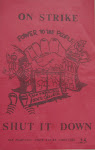
WEI MIN MARCH 1972 VOL.1 N.6

PEOPLE COME FIRST AT THE INTERNATIONAL HOTEL

The International Hotel is located on Kearny and Jackson Street. Built in 1907, the International Hotel has offered low-cost housing to retired farm workers, to the elderly on pensions, and to newly arrived immigrant families in desperate need of housing. Today, it is the home of approximately 130 Filipino and Chinese people, the majority of them elderly single men. As a group, they understand the oppression of this society, and many have suffered much, as this story shows.

THE INTERNATIONAL HOTEL IS THE PEOPLE’S HOTEL


It was a Thursday morning in Everybody’s Bookstore, and as I was attending to a customer, Bill Sorro from the I-Hotel rushed in. His brow was creased, but seeing that I was busy, he turned and hurried out. Within a couple of minutes, Judy Kajiwara, another Hotel worker, came in. She said that they needed a translator, that an old Chinese man was sick upstairs.

Hastily climbing a flight of stairs and arriving at Room 121, I found the Hotel staff already there trying to make things comfortable for the old man. We checked him for fever. He showed no temperature and his pulse felt normal. Someone said the old man was diabetic and hard of hearing as well. We asked him how he was, whether or not he had any aches or pains. After asking several times, he finally answered that he was alright. We then asked him if he had eaten. He nodded no. One of the staff members rushed out to the Star Lunch Cafe around the comer and came back 5 minutes later with some vegetable soup. By that time, the old man had sat up to show that he was alright. He put the soup aside and went to get his trousers which were draped on the chair by the side of his bed. I knew what he was doing but something stopped me as I wanted to watch this proud and noble old man. He was looking for his wallet and finally extracted it from his trousers. At that moment I interjected and said, “No, Uncle, the staff bought it for you.” He graciously thanked us and put his wallet back. The old man really had no money. He was very thin and showed signs he suffered from malnutrition.

Later, the I-Hotel staff discussed the situation and decided that in view of the old man’s diabetic condition he needed a check-up at the hospital and that it was better to send him there.

Worker at Everybody’s Bookstore

I-Hotel Eviction Night August 1977

Reports estimated 3,000 protesters formed a protective human chain around the International Hotel, delaying the eviction until the early morning hours. 300 police and sherriffs stormed the ring of protesters using police clubs and horses. Dressed in riot gear, the police eventually forced the supporters to move away from the front door. After clearing the sidewalk, the sherriffs broke down the doors with sledge hammers and forcibly evicted the tenants inside.

Eviction Night


Sherriffs break down ACC door

After the I-Hotel Eviction


ACC'S Door is boarded shut, demolition notice nailed.
Above photo: supporters descend from rooftop to hang a demolition protest banner.

WE WON'T MOVE Tenants and friends on bench


1974 Bench in front of International Hotel